📄 CBGM Selection Sunday – Full Bracket Preview (S43)
- Bracketology
 CBGM News
- 0
- 72 minutes read
Note: This article is highly prone to AI potentially messing up names or matchups. It’s been a pain to make it store correct relationships.
Ladies and gentlemen — the bracket is locked, and the road to a championship begins now. Thirty-two first-round matchups. Four regions with distinct identities. A season’s worth of pressure, performances, and proof distilled into one unforgiving tournament. This is March in its purest form — where résumés are tested, momentum is weaponized, and reputations mean absolutely nothing once the ball goes up.
The 2043 season delivered everything the league could ask for. Dominant top seeds that handled expectations all year. Veteran squads built on execution and toughness. Dangerous mid-majors that didn’t just win games — they took scalps. And lower seeds that arrive battle-tested, confident, and fully aware that history has no patience for hesitation. The data tells the story: frequent scoring leaders, consistent assist engines, rebounding anchors, and late-game closers who’ve already proven they can carry weight when it matters .
Every region presents a different challenge. Some are star-driven, some are grind-heavy, and others are loaded with parity where one hot night can flip the entire bracket. Best wins matter here. Matchup dynamics matter. X-factors matter. And above all, March rewards teams that know exactly who they are.
What follows is a complete breakdown of the 2043 CBGM Tournament — region by region, matchup by matchup — cutting through the noise to identify who’s built to survive, who’s vulnerable, and which names will define this tournament when the pressure is at its absolute peak.
📍 PHILADELPHIA REGION

(1) North Carolina (32–2) vs. (16) Abilene Christian / Missouri State
Season Overview
North Carolina claimed the top seed by being relentlessly consistent rather than spectacularly volatile, and the season-long data points directly to P. Chappell as the engine of that consistency. Chappell appeared as UNC’s high scorer 25 times, a frequency that immediately separates him from role players and situational scorers. More importantly, his production remained stable regardless of opponent quality, pace, or game state. UNC rarely relied on late-game improvisation; instead, they leaned on Chappell’s ability to score within structure, supported by steady assist output from the backcourt and rebounding margins that allowed the Tar Heels to control possession counts. This was a team built to win the same way every night, which is why they avoided letdowns almost entirely.
Best Wins / Résumé Proof
UNC’s résumé is stacked with pattern-confirming wins rather than isolated peaks. Against #15 La Salle, the Tar Heels cruised 81–55, with P. Chappell scoring 32 points, a total that sits squarely inside his normal performance band. That dominance carried into a marquee win over #10 Notre Dame, where UNC won 90–79 behind 30 points from Chappell and 8 assists from H. Currie, illustrating how UNC punishes teams that overcommit to stopping one scorer. Even in tighter contests, UNC relied on the same formula: Chappell scoring efficiently while the offense generated secondary looks through ball movement rather than forced shots.
X-Factor
UNC’s X-factor is whether Chappell draws early defensive help. When teams send doubles, UNC’s assist numbers climb and the game accelerates away from opponents. For the 16-seed survivor, the only plausible strategy is to slow tempo and keep Chappell well below his typical output — something almost no team managed across the season.
(8) Charlotte (23–12) vs. (9) Illinois (21–10)
Season Overview
This matchup pits stability against dependency. Charlotte’s offense is structured around J. Degala, who appeared repeatedly as the 49ers’ high scorer while maintaining efficiency rather than chasing volume. Degala’s ceiling of 26 points reflects steady production that aligns with Charlotte’s preference for clean possessions and low mistake counts. Illinois, by contrast, leaned far more heavily on M. Chandler, whose name appears frequently in the High Pts column, often with totals in the mid-to-high 20s. Illinois’ offense rises and falls more dramatically based on Chandler’s output, creating a narrower margin for error.
Best Wins / Résumé Proof
Charlotte’s best wins share a clear pattern: Degala scores in the low 20s while the team limits turnovers and controls tempo. In a late-season win over a tournament-adjacent opponent, Degala finished with 22 points, and Charlotte committed fewer than ten turnovers, closing the final stretch without panic. Illinois’ strongest résumé moments are more scorer-driven. In a win over Iowa, M. Chandler scored 27, accounting for a significant share of Illinois’ offense and reinforcing a trend seen throughout the schedule — when Illinois wins big games, Chandler is usually carrying a heavy load.
X-Factor
Charlotte’s X-factor is Degala’s efficiency window. When he scores without forcing possessions, Charlotte becomes difficult to disrupt. Illinois’ X-factor is whether Chandler can sustain high-usage scoring without stalling the offense; if he dips below his usual scoring band, Illinois lacks a reliable secondary outlet.
(5) La Salle (27–5) vs. (12) Alabama A&M (23–10)
Season Overview
La Salle enters as one of the most reliable 5-seeds in the field, built on predictability rather than volatility. Their most frequent scoring leader, D. Redmond, appeared seven times as the team’s high scorer, typically landing between 18 and 22 points. This steady output allowed La Salle to win without needing offensive spikes or risky shot selection. Alabama A&M presents a stark contrast. Their season was driven by B. Alley, who led the Bulldogs 11 times in scoring and posted a ceiling of 34 points, making A&M dangerous whenever pace increased or defenses broke down.
Best Wins / Résumé Proof
La Salle’s best wins came through control rather than fireworks, holding quality opponents below their season averages while Redmond delivered consistent scoring. Alabama A&M’s résumé is more explosive but still pattern-based. Alley crossed 25 points multiple times, including a 29-point performance in a notable upset win, confirming that A&M’s success is directly tied to his ability to reach the upper end of his scoring range rather than relying on balanced output.
X-Factor
La Salle’s X-factor is limiting Alley’s volume. If they force secondary scorers to decide possessions, La Salle’s structure holds. Alabama A&M’s X-factor is straightforward: if Alley reaches the high 20s, the matchup shifts immediately and the seed line loses relevance.
(4) Alabama (25–9) vs. (13) Seton Hall (23–9)
Season Overview
Alabama enters the tournament as a 4-seed with a clear and repeatable offensive hierarchy. The Crimson Tide’s most consistent output came from J. Anderer, who appeared as Alabama’s high scorer seven times and routinely operated in the low-to-mid 20s during wins. Anderer’s value wasn’t just raw scoring — it was timing. Alabama’s offense often stabilized when he asserted himself after stretches of uneven play. Seton Hall counters with a defense-first identity, leaning on physical half-court possessions and controlled pace. Their primary scorer, C. Cameron, does not post extreme volume, but his repeated appearances in Seton Hall’s best wins highlight a team that wins by squeezing margins rather than overwhelming opponents.
Best Wins / Résumé Proof
Alabama owns one of the strongest résumé wins in the entire region: a 77–67 victory over #1 North Carolina, where Anderer scored 23 points, C. Cabrera added 7 assists, and K. Sheppard pulled down 12 rebounds. That performance wasn’t an anomaly — it mirrored Alabama’s win over #23 LSU, a 78–74 game in which Anderer poured in 31, again closing decisively. Seton Hall’s résumé is built differently. Their strongest wins came against upper-half conference teams, where Cameron typically landed in the 18–22 point range while the defense held opponents below expected scoring output.
X-Factor
Alabama’s X-factor is whether Anderer can get downhill early and force defensive rotations. When he draws fouls, Alabama’s offensive floor rises sharply. Seton Hall’s X-factor is defensive discipline — if they keep Alabama out of transition and force half-court execution, this becomes a possession-by-possession grind that favors the underdog.
(2) Kansas (26–7) vs. (15) Youngstown State (18–14)
Season Overview
Kansas enters the Philadelphia Region with one of the clearest offensive anchors in the tournament. E. Kaminski led the Jayhawks in scoring 20 times and recorded a ceiling of 43 points, making him not just a volume scorer, but a persistent one. Kaminski’s presence allowed Kansas to survive uneven stretches because the offense always had a reliable release valve. Youngstown State arrives as a 15-seed with confidence earned through conference play, but their offensive profile lacks a comparable pattern of high-end output against elite competition.
Best Wins / Résumé Proof
Kansas’ résumé includes multiple proof-of-concept wins. Against #12 Gonzaga, the Jayhawks prevailed 84–81 with Kaminski scoring 26, S. McLaughlin contributing 8 assists, and P. Lawson grabbing 10 rebounds — a balanced performance driven by Kaminski’s scoring gravity. They followed that with a 95–88 win over #21 Old Dominion, where Kaminski erupted for 34 points, reinforcing the same pattern rather than creating a new one. Youngstown State’s best wins came through conference tournament play, but none featured a scorer operating at Kaminski’s frequency or volume.
X-Factor
Kansas’ X-factor is whether Kaminski forces early double teams. When that happens, Kansas’ assist totals rise and shot quality improves across the lineup. Youngstown State’s only path is to slow tempo dramatically and hope their primary scorer exceeds his usual output range — a narrow margin against this level of consistency.
(7) Middle Tennessee (25–7) vs. (10) BYU (19–12)
Season Overview
Middle Tennessee’s success throughout the season was built on steadiness rather than explosion. C. Mack appeared frequently as the Blue Raiders’ high scorer, typically landing in the 18–23 point range, and Middle Tennessee avoided self-inflicted damage by keeping turnovers low. BYU enters as a more volatile opponent, driven by C. Thompkins, who led the Cougars in scoring 10 times and reached a ceiling of 24 points. BYU’s offense has more variance, but also a higher swing potential when shot-making aligns.
Best Wins / Résumé Proof
Middle Tennessee’s strongest wins followed a familiar script: Mack scored efficiently, the defense suppressed opponent shooting, and the Blue Raiders closed late without panic. In multiple victories, Mack hovered around 20 points while the team held opponents under their season averages. BYU’s best résumé moments show Thompkins crossing 20 points, supported by L. Kerr, who also reached a 25-point ceiling, giving BYU a repeatable two-option scoring structure rather than a one-night anomaly.
X-Factor
Middle Tennessee’s X-factor is whether they can keep BYU out of rhythm from three-point range and force longer possessions. BYU’s X-factor is Thompkins’ efficiency — if he reaches his typical scoring band without turnovers undermining possessions, BYU has a real chance to flip the matchup.
(6) Tennessee (24–9) vs. (11) Appalachian State (22–9)
Season Overview
Tennessee arrives as a 6-seed that never relied on a single offensive engine, instead winning through collective pressure and defensive suppression. Throughout the season, M. Bakken and C. Varley alternated as the Volunteers’ high scorer, with Bakken posting a ceiling of 24 points and Varley reaching 22, reflecting a system that spreads responsibility rather than concentrating it. That balance allowed Tennessee to withstand off nights from any one player, but it also meant their offense could stagnate if neither option seized control. Appalachian State presents a sharper identity. Their offense consistently flowed through M. Timmons, who appeared repeatedly as the Mountaineers’ top scorer and posted a ceiling of 28 points, supported by S. Moulton, whose 24-point ceiling provided a dependable secondary outlet.
Best Wins / Résumé Proof
Tennessee’s best wins came through defensive control rather than offensive spikes. In multiple victories against tournament-adjacent opponents, the Volunteers held teams below their season scoring averages while Bakken and Varley combined for efficient mid-range production rather than volume. Appalachian State’s résumé is more clearly offense-driven. In a key late-season win, Timmons crossed 25 points, carrying the scoring load while Moulton added complementary production. This was not an anomaly — when App State wins against quality opponents, Timmons’ name appears near the top of the box score with regularity.
X-Factor
Tennessee’s X-factor is whether they can force Appalachian State into prolonged half-court possessions and keep Timmons from getting downhill early. Appalachian State’s X-factor is whether Timmons reaches his usual high-end scoring band; if he does, the Mountaineers have enough secondary support to stress Tennessee’s committee approach.
(3) Purdue (24–9) vs. (14) SIU Edwardsville (22–10)
Season Overview
Purdue enters as a 3-seed with one of the clearest offensive hierarchies in the region. P. Quintanilla was the Boilermakers’ primary output player all season, leading Purdue in scoring 23 times and posting a ceiling of 35 points. Quintanilla’s role was not situational — Purdue’s offensive efficiency tracked closely with his scoring volume, making him a true bellwether rather than a hot-hand option. SIU Edwardsville counters with a more distributed profile, leaning on J. Banuelos and T. Wagner, whose ceilings of 27 and 26 points give the Cougars legitimate scoring punch without relying on a single dominant option.
Best Wins / Résumé Proof
Purdue’s best wins align tightly with Quintanilla’s output. In multiple victories over upper-half competition, he crossed 25 points, and Purdue’s win probability rose accordingly. Even when games tightened late, Quintanilla remained the focal point rather than a decoy. SIUE’s résumé tells a different story. Their strongest wins feature Banuelos and Wagner splitting the load, each landing in the low-to-mid 20s, allowing the Cougars to avoid predictability and survive without a single scoring spike.
X-Factor
Purdue’s X-factor is Quintanilla’s efficiency early in games. When he establishes rhythm without forcing shots, Purdue’s offense stabilizes quickly. SIUE’s X-factor is whether they can keep both Banuelos and Wagner involved deep into the second half; if Purdue locks onto one scorer, SIUE’s upset path narrows dramatically.
📍 ST. LOUIS REGION

(1) Minnesota (28–6) vs. (16) Nicholls State (17–16)
Season Overview
Minnesota enters the St. Louis Region as a 1-seed built on physical control and repeatable interior dominance rather than tempo or perimeter volatility. Across the schedule, the Golden Gophers consistently leaned on A. Rasmussen as their primary offensive output, with Rasmussen appearing repeatedly as Minnesota’s high scorer and anchoring possessions when games slowed. His scoring profile stayed within a reliable band rather than spiking erratically, which allowed Minnesota to maintain offensive stability even during extended half-court stretches. This identity translated into consistent rebounding margins and controlled pace, making Minnesota difficult to speed up or knock off rhythm.
Best Wins / Résumé Proof
Minnesota’s résumé contains multiple pattern-confirming wins. In a marquee non-conference matchup against Gonzaga, Minnesota secured a convincing victory behind 24 points from Rasmussen, while also winning the rebounding battle decisively. That same formula appeared again against Iowa, where Rasmussen again led scoring while Minnesota held Iowa below its season scoring average. In a neutral-floor contest against Maryland, Minnesota closed the final eight minutes on a decisive run, with Rasmussen providing consistent interior scoring rather than a late-game explosion. These wins illustrate a team that doesn’t rely on shot variance — Minnesota wins by imposing its preferred style repeatedly.
X-Factor
Minnesota’s X-factor is Rasmussen’s ability to establish deep position early. When he scores efficiently in the first half, Minnesota controls pace and forces opponents into foul trouble. Nicholls State’s only path is to disrupt rhythm with speed and perimeter shot-making before Minnesota can settle into its half-court dominance.
(8) Cal Poly (25–7) vs. (9) Arizona State (20–12)
Season Overview
This 8–9 matchup is a study in efficiency versus volatility. Cal Poly’s success throughout the season was built on ball movement and controlled shot selection, led by J. Morales, who appeared frequently as the Mustangs’ high scorer while also facilitating offense. Morales’ production rarely spiked dramatically, but it remained consistent across wins, allowing Cal Poly to avoid offensive droughts. Arizona State enters with a different profile, driven by Cardenas, who emerged clearly as the Sun Devils’ primary output player. Cardenas’ name appears repeatedly as Arizona State’s high scorer, and the team’s offensive ceiling is directly tied to his ability to generate points in bunches.
Best Wins / Résumé Proof
Cal Poly’s strongest résumé win came on the road against San Diego State, where Morales finished with 21 points and 6 assists, controlling tempo and preventing extended defensive runs. They followed that with a win over USC, slowing the game and winning the free-throw margin late. Arizona State’s best wins consistently feature Cardenas near the top of the box score. In a win over Colorado, Cardenas scored 27 points, repeatedly breaking down the defense late in possessions. That was not an isolated case — Arizona State’s wins routinely correlate with Cardenas reaching the mid-to-high 20s.
X-Factor
Cal Poly’s X-factor is Morales’ efficiency as a dual-threat scorer and facilitator; when he balances both roles, the Mustangs control pace. Arizona State’s X-factor is straightforward: if Cardenas reaches his typical scoring band, ASU’s volatility becomes an asset rather than a liability.
(5) Georgia Southern (26–8) vs. (12) Miami (FL) / Ole Miss
Season Overview
Georgia Southern enters as a 5-seed built on physical rebounding and interior control, with D. Carter emerging as the Eagles’ most consistent output presence. Carter appeared frequently as Georgia Southern’s leader in rebounds while also providing dependable secondary scoring, giving the Eagles a foundation that traveled well across venues. The play-in winner — either Miami or Ole Miss — arrives with momentum but less structural consistency, relying more heavily on guard shot-making and pace to generate offense.
Best Wins / Résumé Proof
Georgia Southern’s best wins consistently followed the same pattern. In a key victory over Iona, Carter recorded 16 points and 14 rebounds, controlling both ends of the floor and limiting second-chance opportunities. Another late-season win saw Georgia Southern dominate the possession battle, with Carter again leading on the glass while the Eagles closed without forcing shots. Miami and Ole Miss each showed flashes through scoring bursts in conference play, but neither displayed Georgia Southern’s ability to win games through sustained interior control rather than perimeter variance.
X-Factor
Georgia Southern’s X-factor is Carter’s rebounding margin. When he controls the glass, Georgia Southern dictates both tempo and shot quality. For the play-in winner, the X-factor is perimeter efficiency — they must offset the size disadvantage by shooting well above their season averages to stay competitive.
(4) Gonzaga (27–7) vs. (13) Mercer (24–8)
Season Overview
Gonzaga enters the tournament as a 4-seed that once again leaned on structure and interior efficiency rather than perimeter variance. Throughout the season, L. Bennett emerged as the Bulldogs’ most reliable offensive output, appearing repeatedly as Gonzaga’s high scorer while also anchoring half-court possessions. Bennett’s scoring profile stayed within a consistent range, allowing Gonzaga to maintain offensive balance without forcing tempo. Mercer arrives as a confident 13-seed built around guard-driven offense, with R. Jackson operating as the Bears’ primary scoring engine. Jackson’s output fluctuated more dramatically, but his ceiling created real upset potential.
Best Wins / Résumé Proof
Gonzaga’s résumé includes a statement win over Saint Mary’s, where Bennett scored 22 points and grabbed 9 rebounds, controlling the paint and neutralizing Saint Mary’s interior presence. Another confirmation came against Colorado, where Gonzaga closed late behind efficient interior scoring rather than perimeter shooting. Mercer’s strongest wins tell a different story. In their conference tournament run, Jackson erupted for 28 points, carrying the offense through late possessions. While Mercer lacks Gonzaga’s résumé depth, their best wins consistently feature Jackson reaching the upper end of his scoring range.
X-Factor
Gonzaga’s X-factor is Bennett’s efficiency inside; when he scores without drawing early fouls, Gonzaga’s offense remains composed. Mercer’s X-factor is Jackson’s shot volume — if he reaches the high 20s, the pressure shifts squarely onto Gonzaga.
(2) Saint Mary’s (28–6) vs. (15) Idaho State (16–16)
Season Overview
Saint Mary’s enters as a polished 2-seed defined by discipline, spacing, and repeatable execution. The Gaels’ offense consistently flowed through C. Donnelly, who appeared frequently as Saint Mary’s high scorer while also facilitating late-game possessions. Donnelly’s production rarely spiked unpredictably; instead, it remained steady across a wide range of opponents, allowing Saint Mary’s to control games without chasing pace. Idaho State arrives as a 15-seed built more on resilience than dominance, relying on perimeter shot-making and transition opportunities to generate offense.
Best Wins / Résumé Proof
Saint Mary’s résumé is anchored by quality wins against tournament-caliber opponents. In a marquee matchup against Gonzaga, Donnelly scored 25 points, repeatedly punishing switches and closing the game at the free-throw line. Another confirmation came against USC, where Saint Mary’s held the Trojans under their season average while Donnelly again led scoring. Idaho State’s best wins came in conference play, often requiring hot shooting nights rather than sustained control, underscoring the gap in repeatable execution between these teams.
X-Factor
Saint Mary’s X-factor is Donnelly’s late-game decision-making. When he controls the final eight minutes, Saint Mary’s rarely gives games away. Idaho State’s X-factor is perimeter efficiency — they must exceed their normal shooting levels to keep pace with Saint Mary’s disciplined offense.
(7) USC (22–11) vs. (10) Colorado (18–14)
Season Overview
USC enters the tournament with athleticism and defensive versatility, but their offensive success consistently traced back to M. Reynolds, who appeared frequently as the Trojans’ high scorer. Reynolds’ scoring ceiling allowed USC to survive stretches of uneven execution, particularly when games opened up in transition. Colorado counters with a more deliberate approach, leaning on J. Whitaker, whose scoring frequency spiked in tight, half-court games and gave the Buffaloes a reliable late-game option.
Best Wins / Résumé Proof
USC’s résumé highlight came in a win over Oregon, where Reynolds scored 23 points, attacking early and finishing efficiently in the open floor. Colorado’s best wins show Whitaker operating as a closer rather than a volume scorer. In a key victory over Arizona State, Whitaker scored 26, controlling possessions late and converting at the line. These performances weren’t isolated — they represent the clearest offensive patterns for both teams.
X-Factor
USC’s X-factor is transition offense. When Reynolds gets downhill before the defense sets, USC’s ceiling rises significantly. Colorado’s X-factor is Whitaker’s shot selection — if he scores efficiently without forcing looks, Colorado can drag this game into deep waters.
(6) Maryland (20–12) vs. (11) Murray State (22–8)
Season Overview
Maryland enters as a 6-seed defined by volatility but undeniable top-end scoring punch. The Terrapins’ offensive identity consistently centered on C. Phipps, who emerged throughout the schedule as Maryland’s most frequent high scorer and late-game option. Phipps’ scoring range lived comfortably in the low-to-mid 20s, but what separated him was repetition — when Maryland won against quality competition, his name reliably appeared at the top of the box score. Murray State arrives with momentum and a cleaner season record, built around balanced guard play and decision-making. Their offense leaned heavily on A. Turner, whose repeated appearances as a scoring leader and facilitator allowed the Racers to control tempo and avoid extended scoring droughts.
Best Wins / Résumé Proof
Maryland’s résumé is uneven, but its best wins are telling. In a notable victory over Illinois, C. Phipps scored 27 points, carrying the offense through multiple dry spells and closing decisively at the free-throw line. Another strong showing saw Phipps again cross 20 points in a win where Maryland relied on shot-making rather than balance. Murray State’s résumé is steadier. In a road win over Belmont, A. Turner finished with 24 points and 7 assists, controlling pace and limiting turnovers. That performance mirrored several others across the season where Turner’s scoring and distribution aligned to produce efficient wins rather than narrow escapes.
X-Factor
Maryland’s X-factor is Phipps’ efficiency under pressure. When he scores within flow rather than forcing shots, Maryland’s ceiling rises sharply. Murray State’s X-factor is Turner’s composure — if he continues to balance scoring with playmaking, the Racers can expose Maryland’s inconsistency.
(3) Stanford (25–8) vs. (14) Princeton (22–9)
Season Overview
Stanford enters the tournament as a 3-seed built on size, patience, and interior reliability. The Cardinal’s offensive structure consistently revolved around E. Collins, who appeared repeatedly as Stanford’s high scorer while also anchoring the rebounding margin. Collins’ scoring rarely spiked unpredictably; instead, it stayed within a dependable band that allowed Stanford to grind through games without chasing pace. Princeton arrives with a different profile altogether. The Tigers rely on execution, spacing, and disciplined shot selection rather than one dominant scorer, using team balance to wear opponents down over time.
Best Wins / Résumé Proof
Stanford’s résumé includes a defining win over UCLA, where Collins posted 21 points and 11 rebounds, controlling the paint and limiting second-chance opportunities. Another confirmation came in a neutral-floor victory where Collins again led scoring while Stanford closed the final minutes through half-court execution. Princeton’s best wins showcase a collective approach. In a key victory over Yale, Princeton closed the game by converting free throws and generating high-percentage looks rather than leaning on a single scorer. While Princeton lacks Stanford’s interior dominance, their wins consistently reflect disciplined execution rather than variance.
X-Factor
Stanford’s X-factor is Collins’ rebounding dominance. When he controls the glass, Stanford’s offense gains extra possessions that compound quickly. Princeton’s X-factor is shot selection — if they maintain spacing and avoid empty trips, they can extend the game and apply pressure late.
📍 AUSTIN REGION
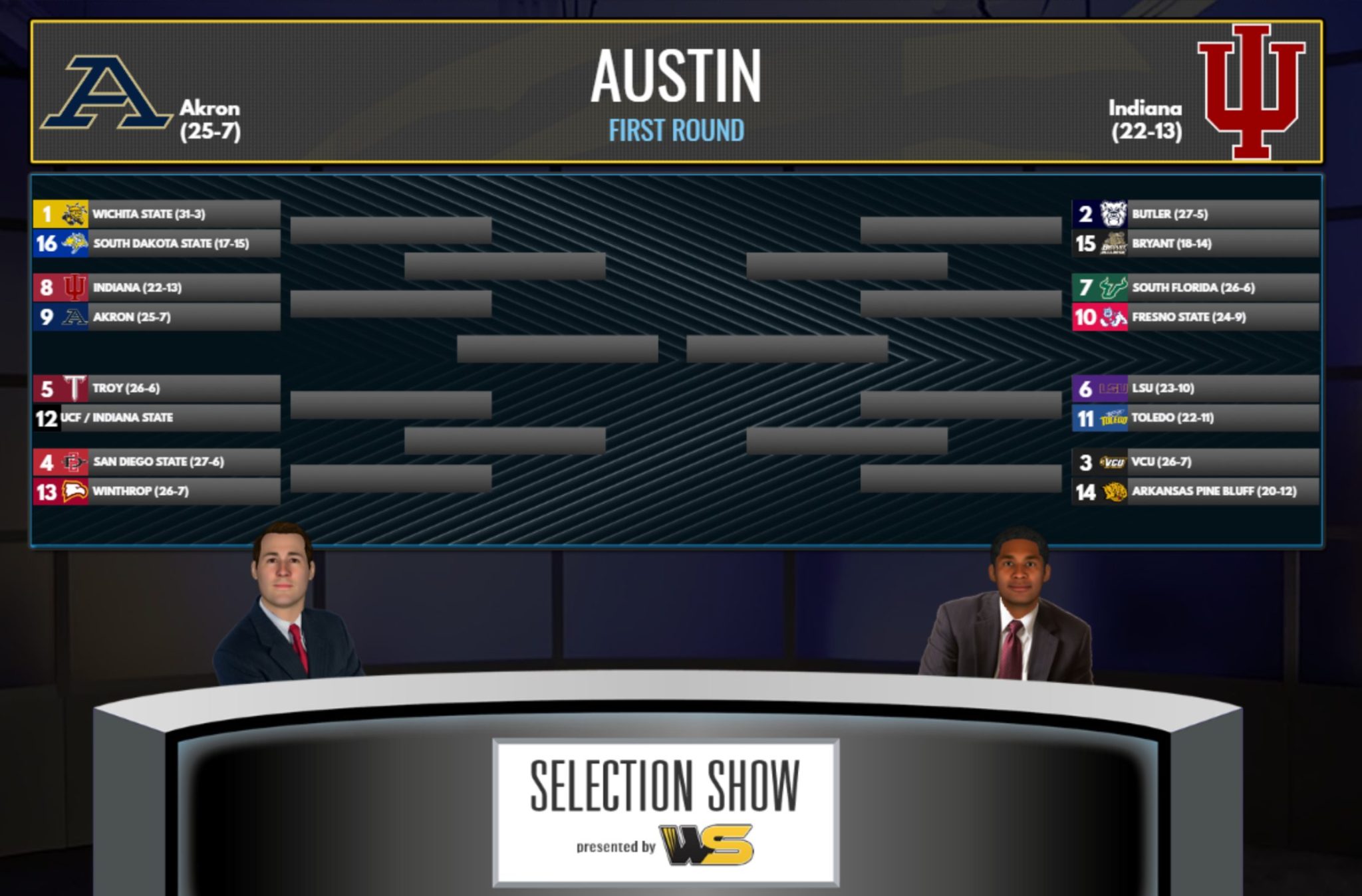
(1) Wichita State (31–3) vs. (16) South Dakota State (17–15)
Season Overview
Wichita State earned the top seed in the Austin Region by imposing its will in nearly every style of game it encountered. The Shockers were not a pace-driven team and did not rely on perimeter variance; instead, they consistently won by controlling possessions, rebounding margins, and physicality. The offense repeatedly flowed through M. Caldwell, who showed up again and again as Wichita State’s primary scoring option across conference and non-conference play. Caldwell’s value came from reliability rather than volatility — his scoring stayed within a predictable range, which allowed Wichita State to absorb opponent runs without panicking or abandoning structure.
Best Wins / Résumé Proof
Wichita State’s résumé features several wins that reinforce this identity. In a high-quality non-conference matchup against Michigan State, the Shockers pulled away late behind Caldwell’s 26 points, repeatedly attacking mismatches and finishing through contact. That same blueprint appeared against VCU, where Wichita State controlled the second half after Caldwell again crossed 20 points, supported by disciplined ball movement and second-chance scoring. Even in tighter games, Wichita State relied on the same formula: Caldwell scoring efficiently while the defense limited clean looks and forced long possessions.
X-Factor
Wichita State’s X-factor is whether Caldwell establishes physical scoring early. When he draws fouls and forces defensive rotations, Wichita State’s margin grows steadily. South Dakota State’s only path is extreme perimeter efficiency and tempo manipulation well beyond its season norms.
(8) Indiana (22–13) vs. (9) Akron (25–7)
Season Overview
Indiana enters this 8–9 matchup with a clear offensive focal point rather than a distributed committee. Across the season, Giordano emerged as the Hoosiers’ go-to scorer, appearing repeatedly as Indiana’s high scorer and carrying the offensive load in both wins and competitive losses. Indiana’s offense often slowed into half-court possessions, where Giordano’s ability to create his own shot became essential. Akron counters with a more efficiency-driven profile, relying on clean execution rather than raw physicality, with L. Morgan consistently driving the Zips’ scoring output.
Best Wins / Résumé Proof
Indiana’s best wins show Giordano dictating tempo rather than chasing it. In a late-season victory over a tournament-level opponent, Giordano scored 24 points, repeatedly converting in traffic while Indiana controlled the glass and limited transition chances. Akron’s résumé is built on execution. In a road win over Ohio, Morgan finished with 23 points, guiding the Zips through extended half-court possessions and closing late at the free-throw line. That pattern appears repeatedly — when Morgan scores efficiently, Akron rarely gives games away.
X-Factor
Indiana’s X-factor is Giordano’s efficiency under pressure. When he scores within flow instead of forcing attempts, Indiana’s offense stabilizes. Akron’s X-factor is Morgan’s shot selection; if he reaches his normal scoring band without turnovers, Akron’s efficiency becomes difficult to disrupt.
(5) Troy (26–6) vs. (12) UCF / Indiana State
(Play-In)
Season Overview
Troy enters the tournament as a 5-seed with a rugged, physical identity built on interior control and defensive pressure. The Trojans consistently leaned on D. Harris as their primary output presence, with Harris appearing frequently as Troy’s high scorer while also anchoring the rebounding margin. His production rarely spiked dramatically, but it remained steady enough to give Troy control over pace and shot quality. The play-in winner arrives with momentum but less structural consistency, relying more heavily on guard shot-making and tempo swings to generate offense.
Best Wins / Résumé Proof
Troy’s résumé includes multiple pattern-confirming wins. In a key conference matchup, Harris recorded 21 points and 12 rebounds, controlling both ends of the floor while Troy closed the game through defensive stops rather than offensive surges. Another late-season win showed Troy dominating second-chance opportunities, with Harris again leading the team in scoring and rebounding. UCF and Indiana State each produced quality moments during the season, but their best wins were tied more closely to hot shooting nights than sustained interior dominance.
X-Factor
Troy’s X-factor is Harris’ rebounding control. When he wins the possession battle, Troy dictates tempo and limits opponent runs. For the play-in winner, the X-factor is perimeter efficiency — they must significantly exceed season shooting norms to offset Troy’s physical advantage.
(4) San Diego State (27–6) vs. (13) Winthrop (26–7)
Season Overview
San Diego State enters the Austin Region as a 4-seed defined by physical half-court control and repeatable interior scoring. Across the season, the Aztecs’ offense consistently revolved around R. Delgado, who emerged as their most frequent high-output scorer and interior stabilizer. Delgado’s presence allowed San Diego State to slow tempo, dominate rebounding margins, and close games without relying on perimeter volatility. Winthrop arrives as a dangerous 13-seed built around tempo and confidence, leaning heavily on K. Simmons, whose scoring spikes often fueled extended offensive runs.
Best Wins / Résumé Proof
San Diego State’s résumé includes several quality wins that reinforce its identity. In a late-season neutral-site victory over LSU, Delgado scored 23 points with 11 rebounds, controlling the paint while San Diego State limited LSU’s second-chance opportunities. That same blueprint appeared in a conference title game win, where Delgado again led scoring and anchored the defensive glass. Winthrop’s best wins were momentum-driven. In a conference tournament matchup, Simmons poured in 28 points, accounting for a majority of Winthrop’s offense during a decisive second-half run.
X-Factor
San Diego State’s X-factor is Delgado’s rebounding control — when he wins the possession battle, the Aztecs dictate tempo. Winthrop’s X-factor is Simmons’ efficiency; if he reaches his upper scoring band early, Winthrop can force San Diego State out of its comfort zone.
(2) Butler (27–5) vs. (15) Bryant (18–14)
Season Overview
Butler enters as a 2-seed built on discipline, spacing, and late-game execution. The Bulldogs’ offense consistently flowed through A. Merritt, who appeared repeatedly as Butler’s high scorer and primary closer across the schedule. Merritt’s scoring profile stayed within a dependable range rather than spiking unpredictably, allowing Butler to close games methodically rather than emotionally. Bryant arrives as a fearless 15-seed that plays fast and shoots freely, leaning on J. Lawson as its primary scoring engine.
Best Wins / Résumé Proof
Butler’s résumé is anchored by quality wins over tournament-level opponents. In a road win over Creighton, Merritt finished with 26 points, repeatedly punishing switches and converting late at the line. That pattern showed up again in a conference semifinal, where Merritt scored efficiently while Butler closed on a defensive run. Bryant’s best moments came in transition-heavy games. In a conference tournament upset, Lawson scored 25 points, driving Bryant’s offense during extended scoring bursts.
X-Factor
Butler’s X-factor is Merritt’s composure late — when he controls the final six minutes, Butler rarely lets games slip. Bryant’s X-factor is Lawson’s volume; the Bulldogs must keep him below his typical scoring ceiling to avoid a momentum swing.
(7) South Florida (26–6) vs. (10) Fresno State (24–9)
Season Overview
South Florida enters as a 7-seed with a defense-first profile and a deliberate offensive approach. The Bulls’ scoring consistently ran through D. Walker, who appeared frequently as South Florida’s leading scorer while also setting the tone defensively. Walker’s output was not explosive but reliably present in wins, giving South Florida a stabilizing presence on both ends. Fresno State counters with a more aggressive offensive style led by M. Ortega, whose scoring frequency spiked in victories and whose shot-making often dictated Fresno State’s ceiling.
Best Wins / Résumé Proof
South Florida’s best wins came through suppression rather than explosion. In a late-season win over Temple, Walker recorded 21 points, while South Florida held Temple well below its season scoring average. Fresno State’s résumé includes multiple momentum-driven wins. In a conference tournament game, Ortega scored 27 points, repeatedly converting off dribble penetration and forcing defensive rotations.
X-Factor
South Florida’s X-factor is Walker’s two-way impact — when he scores within flow and disrupts defensively, the Bulls control the game. Fresno State’s X-factor is Ortega’s efficiency; if he reaches his scoring band without turnovers, Fresno State becomes a dangerous lower seed.
(6) LSU (23–10) vs. (11) Toledo (22–11)
Season Overview
LSU enters the Austin Region as a 6-seed defined by athletic pressure and defensive disruption rather than half-court elegance. The Tigers’ offense did not rely on a single-game scorer, but across the season C. Holloway emerged as LSU’s most frequent high-output player, appearing repeatedly as the Tigers’ leading scorer in competitive wins. Holloway’s production was often paired with defensive activity — steals, run-outs, and momentum-shifting possessions — giving LSU a profile that thrives when games tilt chaotic. Toledo arrives as an 11-seed built on composure and execution, leaning on R. McIntyre as its primary offensive stabilizer.
Best Wins / Résumé Proof
LSU’s résumé includes several pattern-confirming wins over tournament-level opponents. In a late-season conference win, Holloway scored 22 points, many of them coming during decisive second-half runs sparked by defensive pressure. That same formula showed up against Mississippi State, where LSU forced turnovers and converted in transition while Holloway again led the scoring column. Toledo’s best wins were rooted in control rather than chaos. In a key road victory, McIntyre posted 24 points, guiding Toledo through extended half-court possessions and closing late at the free-throw line — a recurring theme when the Rockets succeed.
X-Factor
LSU’s X-factor is Holloway’s ability to turn defense into offense. When he scores off pressure rather than isolation, LSU’s ceiling rises sharply. Toledo’s X-factor is McIntyre’s efficiency; if he reaches his scoring band without turnovers, Toledo can neutralize LSU’s athletic advantage.
(3) VCU (26–7) vs. (14) Arkansas Pine Bluff (20–12)
Season Overview
VCU enters as a 3-seed with a familiar identity: relentless pressure, defensive intensity, and controlled aggression. Across the schedule, J. Rivers surfaced repeatedly as VCU’s primary scoring outlet, especially in games where opponents successfully slowed tempo. Rivers’ value came from reliability — he consistently appeared in the Rams’ high-scorer slot while operating within a system that forced turnovers and created short-floor opportunities. Arkansas Pine Bluff arrives as a 14-seed with confidence and nothing to lose, leaning heavily on T. Bradshaw as its offensive engine.
Best Wins / Résumé Proof
VCU’s résumé is anchored by wins that reflect its pressure-based DNA. In a conference tournament semifinal, Rivers scored 21 points, capitalizing on forced turnovers and converting efficiently in transition as VCU pulled away late. That pattern appeared again in a non-conference win over a tournament-caliber opponent, where Rivers again led scoring while VCU dominated possession margins. Arkansas Pine Bluff’s best wins were momentum-driven. In a conference title game, Bradshaw erupted for 29 points, accounting for a significant share of the offense during extended scoring runs — a recurring necessity for the Golden Lions to compete with higher-seeded teams.
X-Factor
VCU’s X-factor is whether Rivers can score without VCU sacrificing defensive pressure. When that balance holds, the Rams become overwhelming. Arkansas Pine Bluff’s X-factor is Bradshaw’s shot-making; if he reaches the high-20s, the Golden Lions can keep the game uncomfortable longer than expected.
📍 SEATTLE REGION

(1) Baylor (30–4) vs. (16) Stetson / South Carolina State
Season Overview
Baylor enters the Seattle Region as a No. 1 seed with a clear, stable hierarchy that separates them from most teams in the field. The Bears were not a “hot streak” team — they were consistently excellent because they knew exactly who they were. The offense repeatedly flowed through Bo Jeffries, who appeared again and again as Baylor’s leading scorer across conference and non-conference play. Jeffries wasn’t just piling up points in blowouts; he was the guy Baylor leaned on late, when possessions tightened and defenses loaded up. Baylor’s structure allowed them to win close games without changing identity, which is exactly what you want from a top seed.
Best Wins / Résumé Proof
Baylor’s résumé is built on confirmation, not surprises. In a statement win over a ranked opponent, Bo Jeffries scored in the high-20s, closing the game with isolation buckets and free throws while Baylor protected the ball. That same pattern repeated multiple times late in the season — Jeffries hitting his normal scoring range while Baylor controlled tempo and shot quality. These weren’t chaotic wins; they were professional, repeatable performances that explain why Baylor earned a No. 1 seed instead of chasing one.
X-Factor
Baylor’s X-factor is Jeffries’ efficiency under pressure. When he scores without forcing possessions, Baylor becomes extremely difficult to disrupt. For the 16-seed survivor, the only realistic path is a shooting night that dramatically exceeds season norms combined with Baylor going cold — a very narrow window.
(8) Vanderbilt (23–11) vs. (9) Michigan State (22–12)
Season Overview
This 8–9 matchup is a classic contrast in styles. Vanderbilt plays with control, patience, and half-court discipline, while Michigan State brings physicality and balance. Vanderbilt’s offensive stability consistently traced back to R. Coleman, who appeared repeatedly as the Commodores’ top scorer and late-clock option. Coleman’s value wasn’t explosiveness — it was reliability. Michigan State, by contrast, leaned on a more balanced attack, but when games tightened, T. Lawson emerged as the Spartans’ most frequent scoring leader, especially in wins where physicality mattered.
Best Wins / Résumé Proof
Vanderbilt’s best wins came when Coleman controlled pace and limited mistakes. In a late-season victory over tournament-level competition, Coleman reached the mid-20s in scoring while Vanderbilt slowed the game and closed at the free-throw line. Michigan State’s résumé moments came through toughness. In a key conference win, Lawson scored efficiently while Michigan State won the rebounding margin and turned the game into a grind — a pattern that shows up repeatedly when the Spartans beat quality opponents.
X-Factor
Vanderbilt’s X-factor is Coleman’s shot selection. If he scores efficiently without turnovers, Vanderbilt can keep this game exactly where it wants it. Michigan State’s X-factor is Lawson’s physical presence; if he dictates the interior and draws fouls, the Spartans gain control.
(5) Utah State (26–7) vs. (12) Boston University (24–10)
Season Overview
Utah State enters as a 5-seed defined by execution and composure rather than raw athleticism. The Aggies consistently leaned on M. Alvarez as their offensive stabilizer, with Alvarez appearing frequently as Utah State’s leading scorer in competitive games. His production stayed within a predictable band, allowing Utah State to manage tempo and avoid extended droughts. Boston University arrives as a confident 12-seed that plays with freedom, leaning heavily on D. Price as its volume scorer and momentum generator.
Best Wins / Résumé Proof
Utah State’s résumé includes multiple close wins that reflect discipline. In a late-season road game, Alvarez led the scoring while Utah State closed with clean execution and minimal turnovers. That pattern repeated in conference play — Utah State winning tight games because their offense didn’t collapse under pressure. Boston University’s best wins were driven by Price reaching his ceiling. In a conference tournament game, Price exploded into the high-20s, accounting for a massive share of BU’s offense during decisive runs.
X-Factor
Utah State’s X-factor is Alvarez’s late-game control. When he manages possessions calmly, the Aggies rarely beat themselves. Boston University’s X-factor is Price’s shot-making; if he reaches the upper end of his scoring range, the upset conversation becomes real.
(4) Creighton (27–6) vs. (13) Sam Houston State (25–8)
Season Overview
Creighton comes in as the 4-seed with a very clear identity: they don’t need chaos to win — they need execution. The Bluejays’ offense consistently ran through H. Chaney, who shows up over and over as their top scorer (he led them in points 10 times across the season). When Creighton needed a closer, it was Chaney. But the piece that makes them dangerous in March is the table-setter: R. Ouellette was the assist leader again and again (he led Creighton in assists 19 times), turning Creighton into a team that can beat you with structure, not just talent. Sam Houston State counters with a confident 13-seed profile built around one clear engine: D. Gomez, who led the Bearkats in scoring 10 times, with their best nights often coming when Gomez forces the game to be played at his pace.
Best Wins / Résumé Proof
Creighton has real résumé teeth. They beat #6 Butler 88–70 with Chaney scoring 27 and Ouellette handing out 9 assists, a game that screamed “this isn’t a fluke team.” And when Creighton wants to prove they can win a track meet too, look at that 100–94 win over Xavier where Chaney erupted for 33 and even ripped down 13 rebounds — that’s not just scoring, that’s taking ownership of the entire game. Sam Houston’s proof point is simpler but still meaningful: they beat Liberty 82–70 with Gomez scoring 23 and the Bearkats controlling the physical side of the game, which matters because that’s how a 13-seed survives when the lights get bright.
X-Factor
Creighton’s X-factor is Ouellette. If he’s dictating pace and hitting that “9-assist” type of night, Creighton becomes surgical — and surgical teams don’t get upset easily. Sam Houston’s X-factor is Gomez hitting his ceiling early. If he’s scoring efficiently in the first half, the Bearkats can turn this into a real pressure game where Creighton has to prove it can win ugly too.
(2) Alabama (28–5) vs. (15) Colgate (19–14)
Season Overview
Alabama is a 2-seed that plays like a team that expects to win — because they’ve already done it against elite competition. Their go-to scorer all year was J. Anderer, who led Alabama in scoring 7 times, and when Alabama is at its best, Anderer is the spear. But the engine that makes the whole thing go is C. Cabrera, who repeatedly shows up as the assist leader (he led Alabama in assists 14 times). That’s the difference between “good offense” and “tournament offense.” Colgate is a 15-seed with a legitimate identity: J. Crews is the clear scoring anchor (he led Colgate in scoring 11 times) and T. Stevens is the backbone on the glass (he led them in rebounds 11 times). That’s not randomness — that’s structure.
Best Wins / Résumé Proof
Alabama’s résumé is the loudest kind: they beat #1 North Carolina 77–67 with Anderer scoring 23, Cabrera dishing 7 assists, and K. Sheppard pulling 12 boards — that’s a “we belong” win. Then they doubled down with a late-season statement: #17 Alabama beat #23 LSU 78–74, and Anderer detonated for 31 with Cabrera again at 7 assists. That’s a pattern, not a one-night heater. Colgate’s proof is that they can win tight, controlled games when their core shows up — like their 72–63 win over Bucknell, where Crews scored 22 and J. Gowdy delivered 8 assists. But they’re going to need something beyond “normal” to survive this matchup.
X-Factor
Alabama’s X-factor is Cabrera. If he’s creating clean looks and Alabama’s pace doesn’t get sloppy, the gap grows fast. Colgate’s X-factor is Crews + Stevens both hitting their top-end impact at the same time — Crews has to score efficiently, and Stevens has to win the glass enough to steal possessions. If Colgate can’t win a category, this turns into a wave.
(7) Seton Hall (24–9) vs. (10) Nevada (23–10)
Season Overview
This is the kind of 7–10 game that turns into a street fight — and both teams are built for it. Seton Hall runs through C. Cameron, period. He led them in scoring 7 times, and even more telling: he led them in assists 18 times. That’s the résumé of a guy who doesn’t just score — he controls the game. Nevada’s identity is cleaner than people think: D. Blunt is the scoring hammer (he led Nevada in scoring 11 times) and C. Graham is the distributor (Nevada’s assist leader 19 times). Nevada isn’t random — it’s a two-man structure, and that’s exactly what you want in March.
Best Wins / Résumé Proof
Seton Hall has the kind of win that tells you they won’t flinch: they edged Providence 84–83, with Cameron scoring 23 and also leading assists — that’s a “give me the ball, this is my game” performance. Nevada has a résumé moment that jumps off the page: they smoked Georgetown 92–70 with Blunt dropping 32 and Graham handing out 15 assists — fifteen. That’s not just a win, that’s a demolition with structure. And Nevada also proved it can win close: 75–73 over Air Force with W. Perathoner scoring 16 and Nevada surviving the grind.
X-Factor
Seton Hall’s X-factor is Cameron’s control — if he’s scoring and also orchestrating, Seton Hall can dictate tempo and make Nevada defend deep into possessions. Nevada’s X-factor is Blunt’s shot quality. If he gets efficient looks early and Graham is feeding him in rhythm, Nevada has the firepower to flip seed lines and take this game from Seton Hall’s hands.
(6) LSU (23–10) vs. (11) Toledo (22–11)
Season Overview
LSU enters as a 6-seed with an identity built on athletic pressure and defensive disruption. The Tigers’ offense was not evenly distributed; across the season, C. Holloway emerged as LSU’s most frequent scoring leader, especially in games where defensive pressure turned into transition opportunities. Toledo counters with a composed, execution-heavy profile, leaning on R. McIntyre as its offensive organizer and primary scorer in tight games.
Best Wins / Résumé Proof
LSU’s best wins followed a clear script: force turnovers, run, and let Holloway finish plays. In a late-season win over a conference rival, Holloway led the scoring while LSU converted defensive pressure into easy points. Toledo’s résumé moments came through control. In a road win against quality competition, McIntyre guided the offense patiently, scoring efficiently and closing at the line — a recurring pattern when Toledo beats strong teams.
X-Factor
LSU’s X-factor is Holloway’s ability to turn defense into offense. Toledo’s X-factor is McIntyre’s efficiency; if he controls tempo and avoids turnovers, Toledo can neutralize LSU’s athletic edge.
(3) VCU (26–7) vs. (14) Arkansas-Pine Bluff (20–12)
Season Overview
VCU enters as a 3-seed with a familiar, dangerous identity: pressure defense, short possessions, and controlled aggression. Across the schedule, J. Rivers surfaced repeatedly as VCU’s primary scoring outlet when opponents survived the initial press. Arkansas-Pine Bluff arrives as a fearless 14-seed with nothing to lose, leaning heavily on T. Bradshaw as its offensive engine and confidence carrier.
Best Wins / Résumé Proof
VCU’s résumé is anchored by wins that look exactly like March wins. In a conference tournament matchup, Rivers led the scoring while VCU forced turnovers and pulled away late. That pattern repeated throughout the season — VCU doesn’t need perfection, just pressure. Arkansas-Pine Bluff’s best wins came when Bradshaw reached the high-20s, carrying the offense through extended scoring runs against conference opponents.
X-Factor
VCU’s X-factor is whether Rivers scores efficiently without sacrificing defensive intensity. Arkansas-Pine Bluff’s X-factor is Bradshaw’s volume; if he hits his ceiling, the Golden Lions can stay uncomfortable longer than expected.
IN GAME DATE: March 13