📄 CBGM Selection Sunday – Full Bracket Preview (S44)
- Bracketology
 CBGM News
- 0
- 131 minutes read
Note: This article could be prone to AI hiccups. It’s been a work in progress to make it store correct relationships, sources and memory but hopefully it gets better each season.
Selection Sunday always creates two conversations at once. One happens at the top of the bracket, where the one seeds and protected teams start measuring Final Four paths, matchup pockets, and which region feels cleaner than the others. The other happens everywhere else, where the field gets defined by pressure. That is where 8 vs 9 games become coin flips, 5 vs 12 lines become danger zones, and every lower seed starts searching for the one category it can own for 40 minutes. In this field, Boston looks like one of the more volatile regions because it has both top-end stability and several middle-seed games that could turn quickly.
At the top, Notre Dame enters with momentum that feels real rather than decorative. The Irish closed this stretch with back-to-back wins over Stanford and Louisville, which matters because those were not empty résumé lines. They were the kind of wins that showed Notre Dame surviving quality opposition late, exactly when bracket confidence gets built. Minnesota, Stanford, Maryland, Indiana, and Florida State also give this region a second tier with enough quality to keep Boston from being top-heavy in a predictable way.
But the reason Boston feels dangerous is the profile of the teams underneath those protected seeds. Alabama A&M is not a generic double-digit seed after beating Baylor in November. Middle Tennessee has shown it can win the kind of clean, controlled games that travel into March. Georgia Southern is arriving off a conference tournament push. Iowa is sitting on the kind of offense that can make a six seed sweat if the game gets extended. Even the 16 line is unsettled, with Eastern Michigan and Denver still playing into that Notre Dame slot.
That is what makes this region worth slowing down for. It has a credible one seed, real middle-bracket tension, and enough stylistic contrast to produce games that do not all look the same. Some of these matchups project as control games decided by discipline and rebounding margin. Others look like shot-volume battles where one hot scorer can bend the entire scouting report. Boston is not just strong. It is layered.
📍 BOSTON REGION
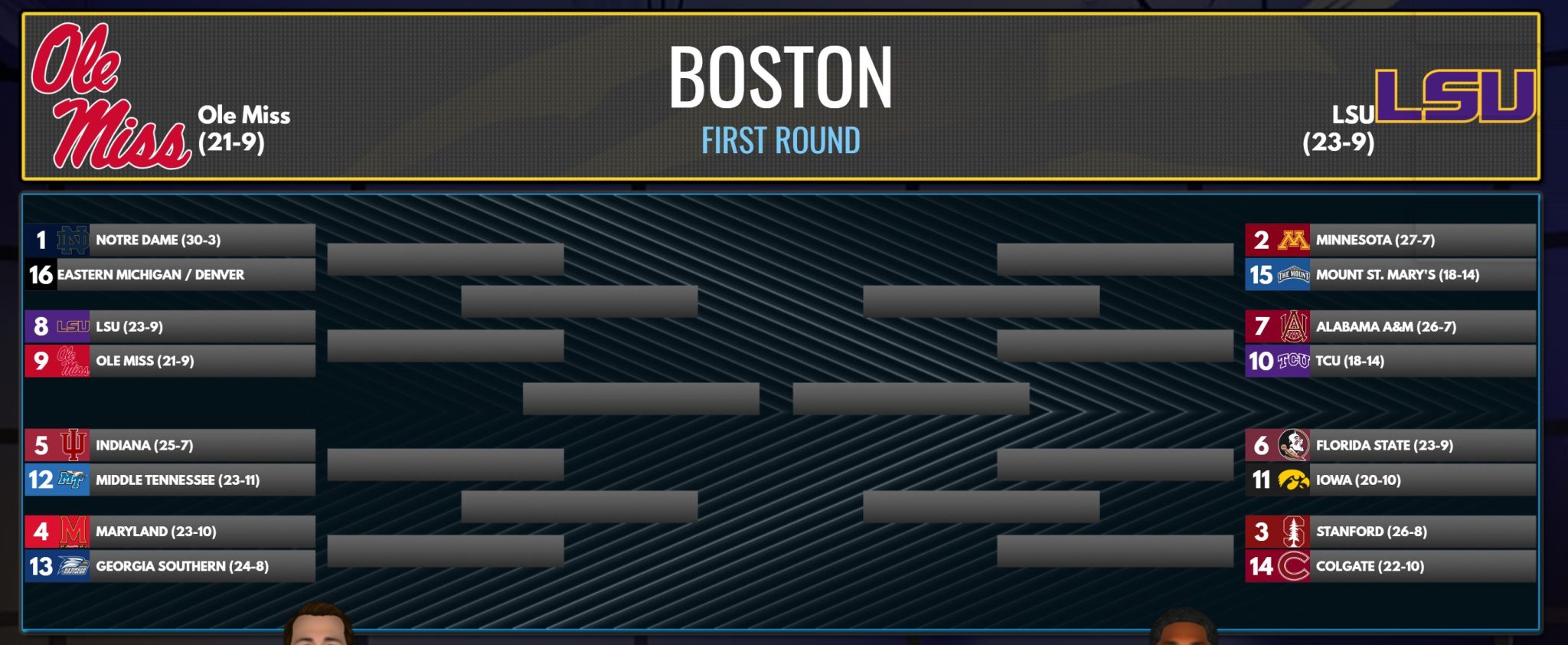
(1) Notre Dame vs. Eastern Michigan / Denver
Season Overview
Notre Dame comes into this region with the clearest two-big foundation in Boston. The Irish are 30-3, have won 10 straight, average 86.7 points per game, and have a frontcourt built around freshman center Bruce Barton and freshman wing Zulu Sullivan. Barton gives Notre Dame true interior volume at 14.4 points and 10.5 rebounds per game, while Sullivan adds 16.3 points and 8.8 rebounds as a scoring wing who can also carry the glass. Around them, senior shooting guard Sinclair Estrada functions as the spacing and connective piece, averaging 12.8 points, 4.0 assists, and 40.9 percent from three. That three-player structure is why Notre Dame looks like more than a standard one seed. The Irish can beat you through post pressure, wing scoring, or ball movement into perimeter shot quality.
Best Wins / Résumé Proof
The résumé is full of games that reinforce the same identity rather than contradict it. Notre Dame beat Gonzaga 85-70 with Notre Dame wing Zulu Sullivan scoring 30 and Notre Dame center Bruce Barton grabbing 11 rebounds. The Irish then went on the road and beat Houston 99-77 with Sullivan posting 25 points and 12 rebounds. They also beat Stanford twice, handled NC State, beat North Carolina, and closed the conference tournament stretch by beating Stanford again and then Louisville. The important part is not just the names attached to those wins. It is that the same personnel keep appearing in the decisive categories: Sullivan as the primary scorer, Barton as the rebounding anchor, and Estrada or point guard Adam Shipley as the table-setter. That is the profile of a one seed with repeatable answers rather than matchup-specific fixes.
X-Factor
The X-factor is whether Notre Dame guard play gets the game organized early enough that the play-in winner never feels settled. Against a 16 seed, the Irish do not need a heroic game from any one player. They need Notre Dame senior guard Sinclair Estrada and Notre Dame senior point guard Adam Shipley to make sure Barton gets deep catches and Sullivan gets volume without forcing difficult possessions. If that happens, Eastern Michigan or Denver is likely reduced to hoping for extreme shot variance. But if Notre Dame opens slowly and lets the first ten minutes turn into a belief game, the underdog at least gains a chance to extend the pressure beyond the opening segment.
(8) LSU vs. (9) Ole Miss
Season Overview
This matchup is balanced because both teams have real backcourt identity, but they get there differently. LSU is steadier and more structured. Senior point guard D.A. Radford runs the Tigers at 11.0 points and 6.2 assists per game, and LSU’s better wins tend to come when Radford is controlling tempo and distributing efficiently. Ole Miss is more volatile, but the Rebels still have a workable creation core through junior point guard Chris Hines, who averages 8.5 points and 6.3 assists, and a schedule profile that shows multiple different players capable of taking the scoring lead on a given night. That split is what makes this game compelling. LSU looks more system-driven. Ole Miss looks more swing-driven.
Best Wins / Résumé Proof
LSU has the stronger top-end proof. The Tigers beat Florida State 75-71, beat Alabama twice, beat Texas 84-75, and also picked off Kentucky late in the year. In those wins, the pattern is not just one scorer going nuclear. It is LSU getting a scoring game from a forward like C. Moreno or F. Barron, then letting LSU senior point guard D.A. Radford control the possession game through assists. Ole Miss’ résumé is thinner at the top. The Rebels started 10-2 and beat teams like Oakland, UT Arlington, Rider, Denver, Liberty, and Furman, but the visible profile is less about marquee results and more about surviving on offense through changing lead options such as Ole Miss guard M. Crenshaw, Ole Miss wing W. Dwyer, and Ole Miss rebounder R. Bolton. LSU has more evidence against tournament-caliber opposition. Ole Miss has enough scoring flexibility to keep this from being a résumé mismatch.
X-Factor
The X-factor is which lead guard dictates the shape of the game. If LSU senior point guard D.A. Radford is getting downhill, creating six-to-eight assist value, and letting the Tigers score through balance, LSU probably looks like the more trustworthy side. But if Ole Miss junior point guard Chris Hines can slow the possession flow, keep LSU out of transition rhythm, and let one of the Rebels’ wings become the featured scorer, Ole Miss can absolutely steal the game. This is the kind of 8-9 matchup where the better organized team often has the safer floor, but the more variable offense can still have the better single-night path.
(5) Indiana vs. (12) Middle Tennessee
Season Overview
Indiana is one of the highest-ceiling teams on the 5 line because the Hoosiers have two elite offensive traits that matter in March. Senior point guard Lamont Hayes averages 14.8 points and 7.6 assists while shooting 51.9 percent from three, and the schedule shows him constantly functioning as the offense’s organizer even when he is not the top scorer. Then there is Indiana guard Mitchell Giordano, whose season includes true eruption games and gives the Hoosiers a scorer capable of bending a matchup by himself. Middle Tennessee is built on almost the opposite model. The Blue Raiders are less explosive individually but more committed to game control. Junior guard Richard Dudley and senior guard Tezale Williams handle much of the offense, while the schedule repeatedly shows Middle Tennessee guard Charlie Mack and Middle Tennessee forward T. Allen appearing in the scoring and rebounding columns. Indiana has the superior shot-making ceiling. Middle Tennessee has the classic 12-seed profile of a team that prefers a disciplined, lower-chaos game.
Best Wins / Résumé Proof
Indiana’s résumé is carried by games where the offensive hierarchy became obvious. The Hoosiers beat Central Michigan 112-96 with Indiana guard Mitchell Giordano scoring 38 and Indiana senior point guard Lamont Hayes handing out 14 assists. Hayes also scored 27 in the opener against Niagara, and Indiana later beat Rhode Island with Giordano scoring 30, then beat Nevada with Giordano exploding for 40. That is not random production. It is repeated evidence that Indiana can survive through either a primary scoring outburst or a true point-guard orchestration game. Middle Tennessee’s best proof is different, but still dangerous for this line. The Blue Raiders beat Davidson, beat Alabama A&M on the road, beat Tennessee, and then beat New Mexico State late. Those wins suggest a team that does not need one star to hit 30. It just needs the game to remain under control long enough for its execution discipline to matter.
X-Factor
The X-factor is whether Middle Tennessee can keep Indiana from turning this into an advantage-creation game for Indiana senior point guard Lamont Hayes. If Hayes is spraying the ball around, forcing rotations, and opening clean looks for Indiana guard Mitchell Giordano and the rest of the lineup, the Hoosiers should look like the more dangerous second-round threat in this region. But if Middle Tennessee junior guard Richard Dudley and Middle Tennessee senior guard Tezale Williams turn this into a possession-by-possession game with fewer transition chances and fewer easy touches, the pressure flips hard onto Indiana. In a 5-12 game like this, the favorite’s ceiling matters less than whether the underdog can force the game into its preferred pace band.
(4) Maryland vs. (13) Georgia Southern
Season Overview
This game starts with one of the most singular players in the entire Boston bracket: Maryland forward E. Wallace. Wallace is the reason Maryland feels dangerous above the usual 4-seed template. On the schedule page he repeatedly shows up as both the top scorer and the top rebounder in major wins, which tells you he is not just a volume option. He is the structure of Maryland’s offense. Georgia Southern, though, is a much more credible 13 seed than the line suggests. Sophomore guard Alex Wheeler averages 10.5 points and 5.4 assists, freshman guard Javan Miller adds 9.3 points, and the schedule consistently shows Georgia Southern wing Speedy Denson and Georgia Southern forward B. Boland shaping their wins through scoring bursts and rebounding control. Maryland has the best individual player. Georgia Southern has enough positional balance to keep the game from becoming a one-man comparison.
Best Wins / Résumé Proof
Maryland’s résumé is anchored by Wallace takeover games. The Terrapins beat Akron with Maryland forward E. Wallace posting 26 and 11, and across the season he kept producing major scoring totals against meaningful opponents: 35 against Old Dominion, 38 against West Virginia, 31 against Minnesota, 26 against Indiana, 41 in one Penn State win, and 39 in the rematch. That is elite repeatability, not a single hot week. Georgia Southern’s résumé is more about pattern than star shock. The Eagles opened hot, got 20- and 23-point games from Georgia Southern wing Speedy Denson, got steady assist work from Georgia Southern sophomore guard Alex Wheeler, and reached the bracket off a conference-tournament push that included a win over Troy where Georgia Southern forward B. Boland dominated the rebounding side. Maryland has much stronger top-end proof, but Georgia Southern has enough multi-player structure to keep the favorite from loading the whole script around one advantage.
X-Factor
The X-factor is whether Maryland gets real secondary creation around Wallace. Everyone already knows Maryland forward E. Wallace can score. The more important tournament question is whether Maryland’s guards can prevent Georgia Southern from turning every high-leverage possession into a Wallace isolation or bailout touch. For Georgia Southern, Georgia Southern sophomore guard Alex Wheeler is probably the key. Wheeler’s 5.4 assists per game make him the player most likely to create the kind of offensive order a 13 seed needs to sustain an upset bid, while Georgia Southern wing Speedy Denson and Georgia Southern forward B. Boland give the Eagles scoring and rebounding support around that creation. If Maryland gets balance, it should survive. If Georgia Southern turns this into a game about possession leverage and offensive patience, the 4-13 line gets much more fragile.
(2) Minnesota vs. (15) Mount St. Mary’s
Season Overview
Minnesota looks like a legitimate 2 seed because the Gophers’ best player is also their lead organizer. Freshman point guard Ethan McManus averages 16.5 points, 5.5 assists, and 5.2 rebounds, which gives Minnesota a rare advantage on this seed line: the same player can control shot creation and tempo. Around him, the schedule shows players like K. Stinnett, J. Bass, L. Hong, and R. Reece repeatedly surfacing in scoring and rebounding support roles, which makes Minnesota feel broader than just a one-guard operation. Mount St. Mary’s is flatter. Sophomore point guard Brandan Smith averages 9.6 points and 4.7 assists, sophomore guard Billy Yoder adds 8.9 points, and the early schedule shows Andre Boardman, M. Fisher, and L. Garner appearing as occasional scoring or rebounding leaders. There are useful pieces there, but not the same top-end control mechanism that Minnesota has in McManus.
Best Wins / Résumé Proof
Minnesota’s résumé has real bracket-level proof. The Gophers beat Gonzaga in November, beat Texas later in nonconference play, beat Maryland in league action, and crushed Michigan 93-71 late. In those better games, the key is not just the final margin. It is that Minnesota freshman point guard Ethan McManus repeatedly appears as the assist leader while different teammates take turns as the top scorer or rebounder. That kind of role flexibility is what makes a 2 seed feel stable. Mount St. Mary’s has much less visible proof. The early sample is mostly losses, including setbacks to Detroit Mercy, Citadel, and Oral Roberts, and while Mount St. Mary’s sophomore point guard Brandan Smith and Mount St. Mary’s sophomore guard Billy Yoder give them some ball-handling and perimeter scoring, there is not an equivalent high-level résumé counterweight in the visible record.
X-Factor
The X-factor is whether Minnesota’s size and structure show up immediately enough to prevent the game from drifting into a shot-variance contest. If Minnesota freshman point guard Ethan McManus is creating clean looks early and the Gophers’ supporting bigs are winning the possession battle, this should resolve the way a 2-vs-15 game is supposed to resolve. Mount St. Mary’s needs the opposite. It needs Mount St. Mary’s sophomore point guard Brandan Smith to keep the ball secure, Mount St. Mary’s sophomore guard Billy Yoder to hit enough perimeter shots to hold the scoreboard together, and the entire game to stay outside Minnesota’s comfort zone. That is a narrow route against a team whose best player can dictate both pace and creation.
(7) Alabama A&M vs. (10) TCU
Season Overview
This is one of the trickiest games in the region because Alabama A&M’s résumé contains a result that changes the emotional reading of the seed line. The Bulldogs beat No. 1 Baylor on the road in November, which is not the sort of thing a generic 10 seed does. Their stats page also explains why they can be annoying to prepare for. Alabama A&M senior point guard Brian Sawyer averages 10.0 points and 3.9 assists, while Alabama A&M senior guard Russ McDonald adds 9.9 points, 5.5 rebounds, and 4.8 assists. That is a balanced backcourt with real connective value. TCU is more perimeter-star driven. TCU senior guard Anthony Hargrove leads them at 12.6 points, and the schedule repeatedly shows TCU scorer J. Cornell as the player who pops in their better games. Alabama A&M looks more distributed. TCU looks more dependent on whether its lead scorers win the shot-making battle.
Best Wins / Résumé Proof
Alabama A&M owns the best single proof point in this matchup by a wide margin. Beating Baylor 81-74 on the road is enough on its own to establish upset credibility, and the Bulldogs also stayed competitive against Texas and beat Villanova later. What stands out is that the Baylor game was not just one absurd 35-point individual performance. It was a team-shaped win, with Alabama A&M senior guard Russ McDonald leading the assist column and Alabama A&M forward B. Alley doing major rebounding work. TCU’s best visible evidence is more mixed but still real. The Horned Frogs lost to Illinois by four, then later beat the Illini 79-75 with TCU scorer J. Cornell putting up 21. They also beat Syracuse early on the road. So TCU has upset-capable evidence too. Alabama A&M just owns the bigger one.
X-Factor
The X-factor is whether the game rewards balance or shot creation. If this turns into a creator-heavy guard game, TCU senior guard Anthony Hargrove and TCU scorer J. Cornell have a strong chance to control the terms. But if Alabama A&M makes this a possession game, with Alabama A&M senior point guard Brian Sawyer and Alabama A&M senior guard Russ McDonald sharing the creation burden and Alabama A&M forward B. Alley affecting the glass, the Bulldogs start to look like the more structurally trustworthy side. That is why this feels like one of the most deceptive first-round games in Boston. One team has the cleaner bracket number. The other may have the better evidence for upsetting stronger opponents without changing its identity.
(6) Florida State vs. (11) Iowa
Season Overview
Florida State and Iowa represent two different March profiles. Florida State is more physical and rebounding-centered. Senior point guard Derek White is not a high-volume scorer, but his 5.1 assists make him the team’s organizer, while junior guard Langston Kerr supplies two-way wing stability. The schedule also keeps surfacing Florida State forward/center J. Worrell, Florida State scorer M. Callier, and Florida State finisher L. Kinzer as the players who shape their best performances through rebounding force or efficient scoring. Iowa is lighter but more fluid. Junior point guard Mike Henry averages 10.8 points, and the schedule repeatedly shows Iowa guard Casey Stewart, Iowa rebounder B. Hall, and Iowa scorer B. Thornton popping in different categories. Florida State wants control and extra possessions. Iowa wants enough pace and offensive looseness to spread the pressure around.
Best Wins / Résumé Proof
Florida State has the better body of work. The Seminoles beat Air Force, Belmont, Saint Joseph’s, LSU, Maryland, and Oklahoma State, and the stronger results usually came with a familiar script: Florida State senior point guard Derek White driving the assist total, Florida State big J. Worrell controlling the boards, and one scorer such as M. Callier or L. Kinzer producing the top line. Iowa’s case is not as deep, but it is credible. The Hawkeyes opened with wins over UT Arlington, New Mexico State, Northern Arizona, and later picked off Washington, Mississippi State, Penn State, and Michigan State. In those wins, Iowa’s identity looked more distributed: Iowa junior point guard Mike Henry as the lead scorer in some games, Iowa guard Casey Stewart as the primary passer, and Iowa rebounder B. Hall repeatedly anchoring the glass. Florida State’s résumé is stronger. Iowa’s upset appeal comes from being able to win through different players without relying on one template.
X-Factor
The X-factor is the rebounding margin. If Florida State big J. Worrell and the Seminoles’ front line are winning second chances, Iowa has to be highly efficient just to keep up with the possession count. But if Iowa rebounder B. Hall neutralizes enough of that advantage and Iowa junior point guard Mike Henry gets help from the rest of the backcourt, the Hawkeyes have the kind of balance that can make an 11 seed very uncomfortable to guard for 40 minutes. Florida State probably has the safer path because its strengths travel more cleanly. Iowa has the more dangerous path if it can keep the game from becoming a size-and-glass contest.
(3) Stanford vs. (14) Colgate
Season Overview
Stanford looks like one of the cleaner 3 seeds in the field because the Cardinal have real role clarity. Senior wing Rashif Winter leads them at 12.5 points and shoots 41.5 percent from three, senior guard Bosko Udovicki averages 4.4 assists, and the schedule keeps showing Stanford’s frontcourt pieces such as D. Davis and J. Byrne in the rebounding column. That is a classic protected-seed build: lead wing scorer, veteran creator, and enough interior control to keep the game from becoming too perimeter-dependent. Colgate is not a hollow 14 seed, though. Senior guard James Gowdy averages 15.8 points, junior point guard McKay Kowalski adds 13.1 points and 4.0 assists, and the Raiders have enough scoring shape that they do not enter this game needing one miracle performance to be competitive.
Best Wins / Résumé Proof
Stanford’s résumé carries better proof and more of it. The Cardinal beat Utah, New Mexico, Charlotte, Purdue by 17, VCU by 27, Iowa State, Iowa, and Florida State. In those wins, the pattern stayed remarkably consistent: Stanford senior wing Rashif Winter or Stanford scorer T. Shipley supplied the scoring lead, Stanford senior guard Bosko Udovicki handled the creation, and the frontcourt won enough rebounds to let the offense stay balanced. Colgate’s résumé is lighter, but still coherent. The Raiders blew out Bethune-Cookman, beat North Dakota State by 19, beat UC Irvine, and entered the tournament on a winning streak. Their best games tend to run through Colgate senior guard James Gowdy as the featured scorer and Colgate junior point guard McKay Kowalski as the secondary creator. Stanford has the superior résumé. Colgate has enough offensive identity that this is not just a number attached to a 14 seed.
X-Factor
The X-factor is whether Colgate can force Stanford to defend multiple actions instead of simply loading up on Colgate senior guard James Gowdy. If the game narrows to Gowdy trying to carry shot volume while Stanford’s rebounding advantage stays intact, the Cardinal should control it. But if Colgate junior point guard McKay Kowalski is creating enough secondary pressure and the Raiders’ frontcourt keeps them even on possessions, the underdog can at least create scoreboard tension. Stanford still looks like the more complete team because it has more ways to reach a winning script. Colgate’s chance is to prove that its backcourt is dynamic enough to stop this from becoming a clean 3-vs-14 separation game.
📍 COLUMBUS REGION
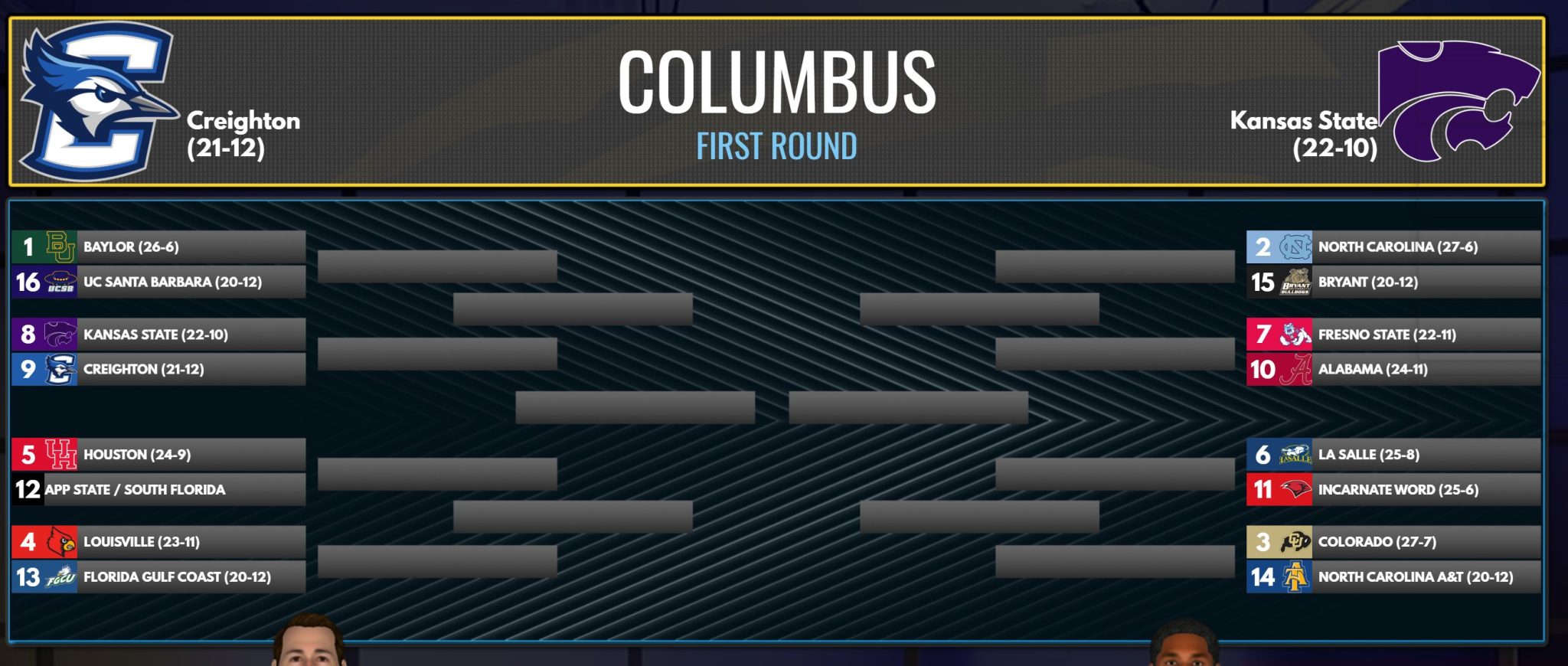
(1) Baylor vs. (16) UC Santa Barbara
Season Overview
Baylor looks like a classic one seed once you move past the early-season scars and focus on what the team became. The Bears are 26-6, rank fourth in NET, average 83.8 points and 43.3 rebounds per game, and bring one of the more complete starting groups in the field. Freshman point guard Kam Owens is the offensive hub at 18.1 points and 7.2 assists per game, senior wing Shaheen Hester adds 13.6 points and 7.8 rebounds, freshman wing Mikael Hartman gives Baylor another 13.1 points, and freshman center Roger Mooney anchors the paint with 13.7 points, 11.3 rebounds, and 2.5 blocks. UC Santa Barbara is a much more balanced but lower-ceiling team. The Gauchos do not have one singular star, but they can spread responsibility across senior point guard Tony Hendrik, junior wing Jackson Safdie, sophomore forward Ronald Law, and senior center Ashley Shipp. That balance gives them competence. Baylor, though, has a much higher gear because its best players operate at protected-seed volume.
Best Wins / Résumé Proof
What makes Baylor dangerous is not that the Bears were flawless. It is that they corrected early instability and turned into a team with repeated proof against strong competition. After the November losses to Alabama A&M and Rhode Island, Baylor ripped through the middle of the year with statement wins over BYU, Kansas, and West Virginia, and those wins showed the exact internal structure the Bears now trust. In the BYU game, Baylor freshman center Roger Mooney scored 23 and grabbed 12 boards. Against Kansas, Baylor freshman wing Mikael Hartman scored 29, Owens handed out 11 assists, and Mooney added a double-double. UC Santa Barbara’s résumé is more modest. The Gauchos come in on a five-game winning streak and have enough veteran shot-making to avoid embarrassment, but their team profile is built around good rotation stability rather than proof against top-10 caliber resistance.
X-Factor
The X-factor is whether Baylor freshman point guard Kam Owens gets the game organized early enough that the size and talent advantage immediately show up. If Owens is creating high-value touches for Mooney and forcing the defense to tag Baylor’s wings, the Bears become a very difficult team to slow for 40 minutes. UC Santa Barbara’s only real route is to keep this from becoming a Baylor frontcourt-and-creation game. That means senior guard Tony Hendrik has to control tempo, Jackson Safdie has to score efficiently as the Gauchos’ best wing finisher, and the bigs have to survive the rebounding margin against Mooney and Hester. The problem is structural. Baylor’s best player is also its primary organizer, and that usually ends these 1-vs-16 games before they become dramatic.
(8) Kansas State vs. (9) Creighton
Season Overview
This is one of the better 8-9 games in the bracket because both teams have frontcourt legitimacy, but the way they create offense is very different. Kansas State is more interior-oriented and more dependent on pressure at the rim. Senior center T.J. Beshara leads the Wildcats at 13.1 points and 7.0 rebounds, junior forward Rakeem Espinoza gives them 12.3 points and 6.7 rebounds, and senior guard De’shawn Johnston handles much of the ball movement at 4.9 assists per game. Creighton is more wing-and-balance driven. Senior wing Hakim Chaney is the most reliable scorer in the matchup at 15.7 points, sophomore forward Anthony Hart adds 13.2 points and 8.7 rebounds, senior point guard Cash Storey gives the Bluejays 12.1 points, and sophomore guard Zachariah Summers piles up 6.5 assists. Kansas State looks more rugged. Creighton looks more interconnected.
Best Wins / Résumé Proof
Kansas State’s better résumé moments show a team that can win through size and discipline, not just perimeter heat. The Wildcats beat Oregon on the road in November, and the early schedule sample already showed Kansas State wing Saul Fife and Kansas State center T.J. Beshara carrying major scoring and rebounding burdens. But Creighton’s case may be more compelling because the Bluejays’ statistical shape explains why they stayed in the bracket conversation even through inconsistency. Chaney is a true lead wing, Hart is the most efficient high-minute frontcourt piece in the game, and Summers’ assist volume suggests Creighton can manufacture better shot quality than a typical 9 seed. The résumé gap is not dramatic either way. The more meaningful distinction is that Creighton’s best players cover slightly more functions at once.
X-Factor
The X-factor is whether Creighton can force Kansas State’s bigs to defend laterally and repeatedly. If Creighton senior point guard Cash Storey and sophomore guard Zachariah Summers are bending the game with ball movement, then Hakim Chaney and Anthony Hart start playing from advantage rather than from static half-court touches. Kansas State’s counter is obvious. If T.J. Beshara and Rakeem Espinoza turn this into a paint-and-glass game, the Wildcats can make Creighton’s more delicate offensive balance work much harder for every point. This feels like one of those matchups where the winner will be the team that gets the style of game it already plays best, not the team with the prettier seed line.
(5) Houston vs. App State / South Florida
Season Overview
Houston is the kind of five seed that does not always look explosive, but usually looks coherent. The Cougars have a clear lead scorer in junior guard Hollis Bremer at 17.6 points per game, real wing support from senior forward Brian Jackson, and a sturdy frontcourt built around sophomore forward Prince Roark and senior center Sherman Keep, who combine for more than 18 rebounds and 21 points per game. That gives Houston a much more physical profile than its seed sometimes suggests. The problem is that the 12 line here is dangerous regardless of who survives. App State has a clean mid-major guard structure with freshman point guard Jerom Conrad at 10.0 points and 6.0 assists and sophomore guard Dorsett Perry at 11.7 points. South Florida is better still on paper: 25-7, NET 40, with a schedule that shows C. Rodriguez, S. Coon, G. Blanchard, and Z. Cantu repeatedly appearing as the key scorers, rebounders, and facilitators. This is not a soft 12-line draw.
Best Wins / Résumé Proof
Houston’s proof is less about one shocking upset and more about having enough serious pieces to survive good teams. The Cougars finished 24-9 in the Big 12, and their statistical shape suggests a team that wins when Bremer scores efficiently, Gabe Wilson keeps the ball organized, and Keep/Roark own enough of the interior battle. That is the résumé foundation of a five seed that can look like a four when the matchup turns physical. South Florida, though, would be a completely real upset candidate if it reaches this game. The Bulls won 25 games, beat Boston College on the road, beat UAB, Memphis, Wichita State, and North Texas during league play, and repeatedly rode C. Rodriguez as the lead scorer while G. Blanchard cleaned the glass. App State’s résumé is quieter, but the Conrad-Perry backcourt pairing gives the Mountaineers enough control to make Houston work. The identity difference matters: Houston wins through body blows, while either 12 seed could force the game into more backcourt decision-making.
X-Factor
The X-factor is whether Houston can keep the game in the hands of its front line. If Houston junior guard Hollis Bremer is getting his scoring without needing to rescue every possession and Sherman Keep is dominating the glass, the Cougars should look like the stronger team. But a South Florida matchup in particular could get dicey because C. Rodriguez has repeated high-usage scoring games, and the Bulls’ better wins show a team comfortable winning through changing player-of-the-game scripts. App State’s route is slightly different. The Mountaineers would need Jerom Conrad to fully control pace and let Dorsett Perry turn secondary scoring into pressure. Houston has the stronger body of work, but this is exactly the type of 5-12 game where the favorite’s structure is going to be tested every possession.
(4) Louisville vs. (13) Florida Gulf Coast
Season Overview
Louisville is dangerous because the Cardinals have one of the best true interior anchors anywhere on the 4 line. Freshman center Demaine Gilchrist averages 15.5 points and 13.0 rebounds per game, and the schedule repeatedly shows him doing exactly what tournament-winning bigs do: carrying the glass, living at the foul line, and giving his guards a constant release valve. Around him, junior guard Adam Strandmark adds 13.3 points, junior forward Marque Alford gives Louisville another 12.4 points and 7.0 rebounds, and senior point guard Ivory Shaw handles much of the distribution. Florida Gulf Coast is built much more from the perimeter. Senior point guard Julius Mills averages 16.3 points and 4.9 assists, senior guard Aiden Knowles adds 14.3, and the Eagles are at their best when those two control the game’s shot-volume side. Louisville wants to make this about power. FGCU wants to make it about guard creation.
Best Wins / Résumé Proof
Louisville’s résumé includes exactly the sort of wins that matter in a region like this. The Cardinals beat Notre Dame 75-73, beat Duke by 14, beat Miami by 20, beat Mississippi State on the road, and nearly took down Minnesota in overtime. In the better results, Louisville freshman center Demaine Gilchrist was almost always the central force, whether as the top scorer or the top rebounder. That gives Louisville a stable tournament identity. FGCU’s résumé is more about whether the backcourt can dictate the game. Mills and Knowles form a real scoring pair, and that combination is enough to make the 13 seed feel respectable rather than decorative. But the Eagles do not bring the same proof against nationally relevant competition that Louisville does, and that matters when the favorite has the best interior player in the matchup by a wide margin.
X-Factor
The X-factor is whether Florida Gulf Coast can keep Louisville freshman center Demaine Gilchrist from turning this into an extra-possession game. If Gilchrist is getting to his usual rebounding volume and Ivory Shaw is entering the ball cleanly, Louisville’s offense becomes much more stable than its seed-line volatility suggests. FGCU’s path is to let Julius Mills and Aiden Knowles force Louisville into more guard-to-guard exchanges and test whether the Cardinals can defend without constantly funneling everything back to Gilchrist’s size. Louisville is the better team when the game has shape. FGCU becomes interesting only if it can make the game live on the perimeter.
(2) North Carolina vs. (15) Bryant
Season Overview
North Carolina has one of the more modern-looking two-seed profiles in the bracket because the Tar Heels’ guard line does so much of the offensive lifting. Sophomore point guard Harry Currie averages 16.6 points and 4.6 assists, senior guard Hunter Storey adds 11.9 points and shoots 45.3 percent from three, and the schedule shows bigger frontcourt pieces like A. Thompson, J. Thompson, and R. Williams filling in the rebounding and secondary scoring roles. That makes Carolina a difficult matchup because the guards can create, the wings can space, and the rebounding support is good enough that the team does not play small in the bad sense. Bryant is a credible 15 seed by lower-line standards. Senior point guard Greg Abrams averages 10.5 points and 4.6 assists, junior guard Ryan Maddox gives the Bulldogs 12.4 points, and the team’s structure suggests a respectable two-guard scoring base. But there is a difference between respectable and protected-seed caliber, and North Carolina owns that gap here.
Best Wins / Résumé Proof
The Tar Heels have real proof against quality opponents. They opened by beating Wichita State, later handled Louisville 74-58, played Stanford to a two-point road loss, and built a 27-6 season on a defense allowing just 64.2 points per game. More importantly, the best wins show the internal shape of the team. North Carolina sophomore point guard Harry Currie is often the scoring engine, while Hunter Storey and the frontcourt pieces alternate as the supporting pressure points. Bryant’s résumé is thinner and more dependent on its backcourt holding up every night. That can be enough to win a lower-major conference or trouble a shaky favorite, but against a two seed with this much defensive credibility and this many reliable creators, it is a steep jump in class.
X-Factor
The X-factor is whether North Carolina sophomore point guard Harry Currie gets downhill often enough that Bryant’s defense has to collapse and expose itself to Hunter Storey’s shooting. If that happens, Carolina looks like a second-weekend team, not just a team surviving the first round. Bryant’s only real route is a huge efficiency game from Greg Abrams and Ryan Maddox, where the Bulldogs keep the possession count low and turn this into a shot-making stress test. But the Tar Heels’ profile is built to avoid exactly that scenario. They are not dependent on one scorer, and their defense is too strong to make a 15-seed path feel wide.
(7) Fresno State vs. (10) Alabama
Season Overview
This is one of the most interesting 7-10 games in the region because Fresno State already owns the most relevant proof point in the matchup: the Bulldogs beat Alabama 73-70 in Tuscaloosa on opening night. Fresno State is not star-heavy in the usual sense, but it is coherent. Junior point guard Wright Murdock averages 10.8 points and 4.5 assists, freshman guard Jude Peterson leads the team at 13.3 points, and the schedule repeatedly shows frontcourt names like M. Abrams and C. Bailey carrying major rebounding burdens. Alabama has the more recognizable lead scorer in senior guard Jerry Anderer, who averages 16.0 points, but the Tide’s profile is more fragile than it looks because the team leans heavily on Anderer’s shot creation while freshman point guard Lukas Diaz carries a large assist load and turnover burden. Fresno State feels steadier. Alabama feels hotter and colder depending on whether its lead scorers are efficient.
Best Wins / Résumé Proof
The opening-night win matters because it was not a fluke box score. Fresno State beat Alabama on the road with Fresno State junior point guard Wright Murdock scoring 17 and handing out 6 assists, while M. Abrams controlled the glass with 11 rebounds. That is exactly the kind of result that translates into first-round belief. Fresno State’s résumé is not only that game either. The Bulldogs won 22 games, and their scoring structure looks repeatable enough to hold against quality guards. Alabama’s résumé has more brand value than clean reliability. The Tide recovered from the Fresno loss to win 24 games, but their best case is still heavily centered on Jerry Anderer as the one player most capable of warping a matchup. In a 7-10 game, the team with the better shared structure often has the safer floor.
X-Factor
The X-factor is whether Alabama can stop this from becoming another Wright Murdock control game. If Alabama senior guard Jerry Anderer is getting his scoring at efficient volume and Lukas Diaz is creating without turning the ball over, the Tide have enough top-end perimeter talent to flip the earlier result. But Fresno State already showed the better blueprint. The Bulldogs can spread responsibility more naturally, and if Jude Peterson becomes the primary scorer while Murdock handles the decisions, Alabama has to prove it can win a high-pressure game through balance rather than pure shot creation. That is the real question in this matchup. Which team is actually easier to trust when the script tightens late? Fresno State has the better answer so far.
(6) La Salle vs. (11) Incarnate Word
Season Overview
La Salle is one of the more intriguing six seeds in the field because the Explorers are not built around one massive usage monster. They are built around a very clear rotation of responsibilities. Senior wing Steven Nelson is the primary scorer at 15.5 points, junior guard Josh Hedde adds 12.2, freshman point guard Humphrey Jarvis gives them 5.1 assists, and the schedule repeatedly shows frontcourt pieces like R. Hawkins, G. Crooks, and M. Cherry owning the glass in different games. Incarnate Word is more guard-centered. Junior point guard Edmund Kapuscinski averages 10.8 points and 5.5 assists, freshman guard Luther Coleman spaces the floor, and the schedule shows Leonardo Morel, Gerard Grimes, J. Moon, and M. Banuelos surfacing in the scoring and rebounding columns. La Salle is cleaner and more proven. Incarnate Word is a little less settled, but dangerous enough to make the line interesting.
Best Wins / Résumé Proof
La Salle’s résumé has enough quality to make the Explorers feel more like a five than a vulnerable six. They opened by crushing Tennessee 92-55, beat Providence on the road, and built a 25-8 season around consistent scoring from La Salle senior wing Steven Nelson and repeat playmaking from Humphrey Jarvis. In the better wins, Nelson repeatedly sits in the 20-plus band, while Jarvis pushes the assist totals and the frontcourt helps keep the team from becoming too perimeter-dependent. Incarnate Word’s case is more specific. The Cardinals won 25 games and showed enough early proof by beating Bradley and winning their league tournament path, but their profile is more backcourt-reliant. If Kapuscinski is not controlling the game and Morel/Coleman are not making shots, the shape gets thinner quickly. La Salle simply has more ways to look like itself.
X-Factor
The X-factor is whether La Salle freshman point guard Humphrey Jarvis can keep this from becoming a scramble game. If Jarvis is controlling tempo and Steven Nelson is getting his usual efficient wing scoring, La Salle should have enough balance to survive. Incarnate Word’s upset path depends on junior point guard Edmund Kapuscinski turning this into more of a creator contest, where the Cardinals’ guards get the game into space and force La Salle to defend without constantly leaning on its usual team-wide shape. This is a good example of why 6-11 games are tricky. La Salle is better at being complete. Incarnate Word could still win if the best guard on the floor owns the final ten minutes.
(3) Colorado vs. (14) North Carolina A&T
Season Overview
Colorado is one of the most explosive teams anywhere on the 3 line because the Buffaloes can score without looking dependent on one narrow formula. Junior point guard John McCarthy averages 10.4 points and 5.5 assists, junior guard Larry Barker adds 11.9, and the schedule makes it clear that L. Platt is the true high-end scorer and rebounder in Colorado’s biggest wins. The Buffs average 84.3 points per game and have multiple players capable of carrying a scoring night. North Carolina A&T is more straightforward. Senior guard Dandre Morales leads the Aggies at 13.9 points, junior wing Woody O’Brien adds 10.3 and 5.0 rebounds, senior point guard Cornelius Fountain handles 4.7 assists, and the frontcourt gets useful minutes from J.D. Richardson, Brett Sharp, and Dennison Kraft. The Aggies are organized enough to compete. Colorado, though, plays with a much more obvious top-half-of-the-bracket ceiling.
Best Wins / Résumé Proof
Colorado’s early schedule tells you a lot about why the Buffaloes got protected-seed treatment. They beat Florida by 20, beat Davidson by 31, beat Memphis 101-80, later won an overtime game against Arizona, and closed with a résumé strong enough to earn a 3 seed despite the usual Big 12 bruising. In several of those wins, Colorado scorer L. Platt was the player of the game, while John McCarthy handled the creation and the frontcourt cleaned up the glass. That is the profile of a team that can win fast or win through control. North Carolina A&T’s résumé is much more modest, but the player structure is real. Dandre Morales is a credible lead guard scorer, Woody O’Brien gives the Aggies wing support, and the frontcourt has enough size to avoid being blown off the floor immediately. What they do not have is Colorado’s evidence against high-level opponents.
X-Factor
The X-factor is whether North Carolina A&T can prevent Colorado junior point guard John McCarthy from organizing the game too cleanly. If McCarthy is getting downhill and Larry Barker plus the rest of the Buffalo wings are turning that into perimeter rhythm, Colorado has too many scoring routes for the Aggies to survive four quarters of pressure. North Carolina A&T’s best path is a huge game from senior guard Dandre Morales, plus enough offensive steadiness from Cornelius Fountain and Woody O’Brien to keep Colorado from pulling away through shot volume. But the structural edge is still clear. Colorado has more creators, more proven scoring explosions, and more evidence that those explosions hold up against tournament-level teams.
📍 ATLANTA REGION
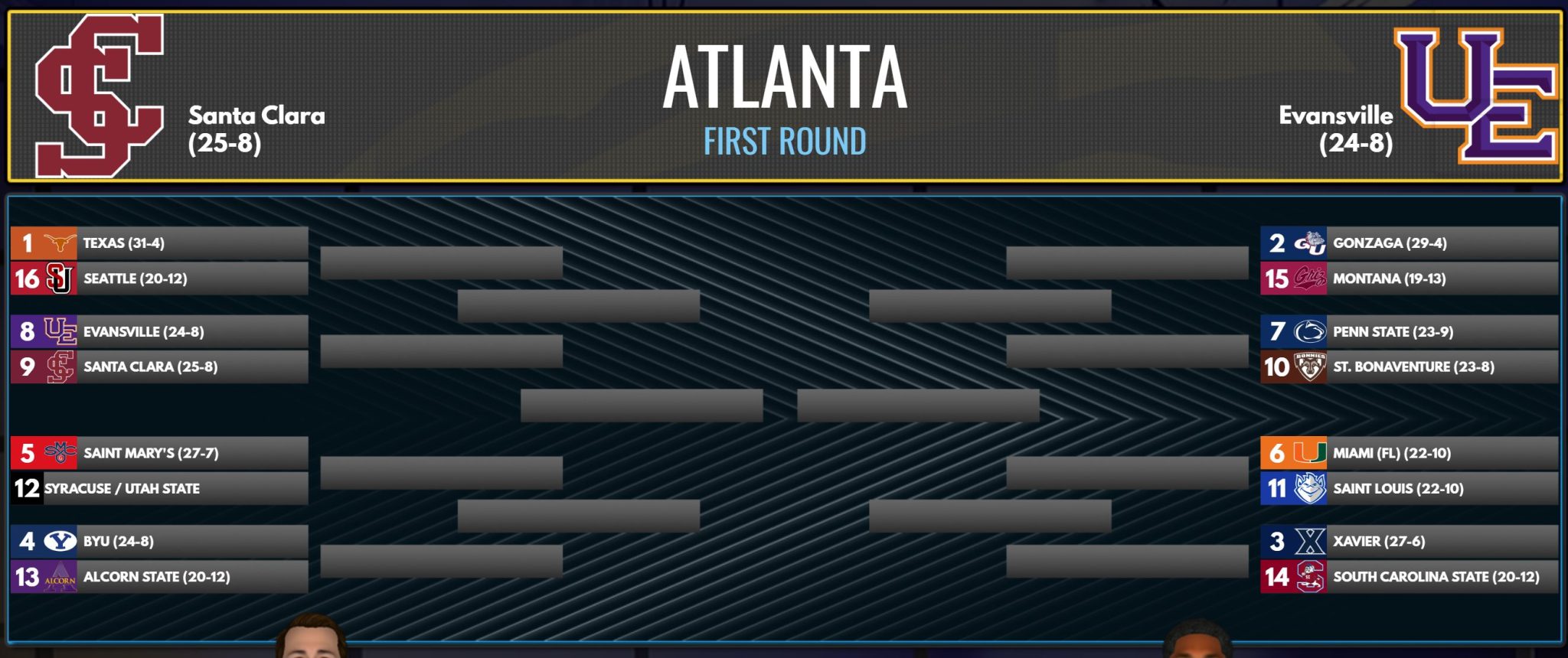
(1) Texas vs. (16) Seattle
Season Overview
Texas enters Atlanta looking like one of the most structurally sound one seeds in the field. The Longhorns are 31-4, rank third in NET, allow only 64.4 points per game, and do not rely on one player to carry every category. Freshman guards Vassili Tsouderos and Franklin Crawford give Texas two perimeter scorers who can both create and space, while junior forward Todd Dobbins and freshman forward Rashid Travis give the Longhorns real frontcourt weight on the glass. Seattle, by contrast, is more backcourt-dependent. Junior point guard Horace Heard leads the Redhawks in assists at 5.8 per game, while senior wing Deaven Courtney is the top scorer at 12.3 points and also one of their better rebounders. That gives Seattle a clear offensive shape, but not the same two-way depth Texas brings into the game.
Best Wins / Résumé Proof
Texas has the kind of résumé that keeps reinforcing the same conclusion: the Longhorns can win through different player-of-the-game scripts without losing their identity. They beat Connecticut 74-63 with Texas freshman guard Franklin Crawford scoring 30, beat Baylor 72-63 with Texas junior forward Todd Dobbins posting 20 points and 12 rebounds, and later beat Florida 90-78 with Dobbins again leading the scoring while Texas freshman forward Rashid Travis grabbed 13 boards. Even their conference wins over Alabama and Tennessee showed the same balance, with Tsouderos, Crawford, and Dobbins alternating as the decisive piece. Seattle’s résumé is much thinner. The Redhawks lost early to Wright State and Norfolk State before settling in, and the visible sample suggests that when Seattle competes well it usually comes from Seattle senior wing Deaven Courtney doing the scoring while Horace Heard handles the possession game. That is functional. It is not remotely the same level of proof Texas carries into this pod.
X-Factor
The X-factor is whether Texas junior forward Todd Dobbins turns this into a glass-and-second-chance game immediately. If Dobbins and Travis are controlling possessions, then Texas guards Vassili Tsouderos and Franklin Crawford can play downhill without forcing difficult offense. Seattle’s only real path is to make this a perimeter decision game, where Seattle junior point guard Horace Heard can stretch the first half with assists and Deaven Courtney can score enough to keep belief alive. But Texas is unusually hard to stress on this line because the Longhorns can win through guard scoring, frontcourt rebounding, or both at once.
(8) Evansville vs. (9) Santa Clara
Season Overview
This looks like one of the more balanced 8-9 games in the entire bracket because both teams have a clear primary scorer and a clear lead organizer, but they arrive with different stylistic strengths. Evansville leans on junior guard Gary Avery, who averages 16.3 points and shoots 46.3 percent from three, while junior point guard Clayton Conrad drives the offense with 6.3 assists per game. Santa Clara is more wing-balanced. Senior guard Emmett Keeling leads the Broncos at 14.1 points, senior guard Carlos Parker adds 10.5 points and 5.7 assists, and senior forwards Anthony Holland and Ross Campbell give Santa Clara two reliable rebounding/scoring wings. Evansville has the more explosive top scorer. Santa Clara may have the more complete two-way wing structure.
Best Wins / Résumé Proof
Evansville’s résumé is built less on one giant national statement and more on a steady Missouri Valley climb, but the team’s better nights still reveal a repeatable pattern. In the early win over Mercer, Evansville junior guard Gary Avery scored 23 while Clayton Conrad handed out 9 assists and A. Peppers controlled the glass. That trio tells you how the Purple Aces want to win: Avery as the shot-maker, Conrad as the organizer, and the frontcourt finishing possessions. Santa Clara’s best proof is subtler but compelling. The Broncos went 25-8 and have multiple veteran perimeter pieces, and even in an early road loss at Indiana, Santa Clara senior guard Emmett Keeling still put up 23 while Carlos Parker handled creation and Anthony Holland was active on the boards. That matters because 8-9 games often turn on whether a team’s core functions survive against tournament-caliber athletes. Santa Clara’s did.
X-Factor
The X-factor is whether this becomes an Avery game or a Parker-Holland game. If Evansville junior guard Gary Avery gets into rhythm from three and Clayton Conrad can keep Santa Clara’s wings from flattening the pace, Evansville probably has the most dangerous single scorer on the floor. But Santa Clara has a better chance of making this a layered possession game. Santa Clara senior guard Carlos Parker is the best pure distributor in the matchup, while Anthony Holland and Ross Campbell give the Broncos more ways to survive if Keeling is not carrying the scoring column by himself. This feels like a classic 8-9 hinge game: the team with the cleaner star guard may win the night, but the team with the broader wing structure may be easier to trust over 40 minutes.
(5) Saint Mary’s vs. Syracuse / Utah State
Season Overview
Saint Mary’s enters as a very real five seed because the Gaels are deep enough that the identity does not collapse when one player has a quiet game. Junior point guard Nate Woolfolk averages 10.1 points and 4.8 assists, freshman guard Kemal Rose adds another 10.1 points while shooting 46.7 percent from three, and the schedule shows names like K. Marsh, R. Garza, and C. Wane repeatedly surfacing as the scoring or rebounding tone-setters in different wins. That is a dangerous March profile because it suggests Saint Mary’s can win through multiple internal versions of itself. Syracuse would bring a very different challenge. The Orange lean on senior guard Dane Rush for 12.4 points per game, with freshman point guard Tre Steen handling much of the passing load. Utah State, meanwhile, is the more star-driven team in the play-in, because senior shooting guard John Moore averages 20.9 points and is clearly the most explosive single scorer attached to this slot.
Best Wins / Résumé Proof
Saint Mary’s résumé is stronger than a typical five seed’s because the Gaels have both consistent record strength and enough player-of-the-game diversity to avoid looking one-dimensional. Early in the year they beat Texas State with K. Marsh scoring 21, beat Wofford with R. Garza exploding for 29, and then beat Illinois State with Saint Mary’s junior point guard Nate Woolfolk scoring 22. That variation matters. It means the opponent cannot just erase one option and feel safe. Syracuse’s visible résumé is more uneven. The Orange beat Toledo and UNC Wilmington early, with F. McGowan leading the scoring and M. Best controlling the glass, but they also lost to TCU in a game where Best had to carry too much of the burden. Utah State is the most dangerous team in this slot from a single-game perspective. The Aggies beat Evansville with Utah State senior shooting guard John Moore scoring 25, and then even in a loss at Louisville, Moore still had 27. That is the sort of offensive anchor who can distort a first-round game if he gets hot.
X-Factor
The X-factor is whether Saint Mary’s can force this game to be about structure instead of star pressure. Against Syracuse, that likely means making Syracuse senior guard Dane Rush and freshman point guard Tre Steen play against a deeper, more flexible backcourt. Against Utah State, it means preventing Utah State senior shooting guard John Moore from turning the game into a personal scoring contest while also controlling secondary creation from Shamar Jackson. Saint Mary’s is safer when Nate Woolfolk is distributing, Kemal Rose is spacing, and the frontcourt rotates its rebounding responsibilities normally. But of the two play-in teams, Utah State clearly presents the narrower and more dangerous high-end path because Moore is the kind of scorer who can make a five seed feel under-seeded in a hurry.
(4) BYU vs. (13) Alcorn State
Season Overview
BYU is one of the more interesting four seeds in the bracket because the Cougars are built around a lead guard who does a little of everything and a wing line that can score in parallel. Freshman point guard Elijah Faulkner averages 13.0 points, 5.7 assists, and 5.4 rebounds, which makes him one of the most important table-setters on this entire seed line. Around him, guards Colin Rice and Ronny Collier both average 12.2 points, giving BYU a repeatable three-guard scoring structure. Alcorn State is not nearly as dynamic, but the Braves do have a working offensive spine. Senior point guard Adam Grigsby averages 13.0 points and 5.0 assists, junior guard Wayland Rude adds 11.5 points, and wing Campbell McCoy gives them 10.1 points and 4.5 rebounds. That gives Alcorn more backcourt functionality than a lot of 13 seeds. It just does not give them BYU’s ceiling.
Best Wins / Résumé Proof
BYU’s résumé has real protected-seed substance because the Cougars have already shown they can beat high-level opponents through the same formula they will need in March. They beat North Carolina 91-76 with BYU guard C. Thompkins scoring 21 and Elijah Faulkner posting 9 assists, which is exactly the kind of proof-of-concept result a four seed wants on its sheet. Even the season-opening loss to Seton Hall showed BYU’s basic structure clearly: Colin Rice could score, Landon Heward could rebound, and Faulkner could organize. Alcorn State’s résumé is much thinner. The Braves lost at Pacific and Abilene Christian before stabilizing, and their visible wins rely much more on whether Adam Grigsby can create enough for Wayland Rude and the wings to finish. That can carry a team through its league. It is much harder to sell as a formula against a top-half at-large team with three perimeter scorers.
X-Factor
The X-factor is whether BYU freshman point guard Elijah Faulkner can keep the game flowing without needing BYU to live on pure shot variance. If Faulkner is getting to his usual assist range and Colin Rice and Ronny Collier are both threatening the defense, BYU becomes a difficult first-round opponent because the scoring pressure comes from multiple angles. Alcorn State’s upset path depends on Adam Grigsby narrowing the game into a guard-control script and making sure Wayland Rude and Campbell McCoy can score efficiently enough that BYU never gets fully comfortable. But structurally this is a bad draw for a 13 seed. BYU’s best creator is also its best all-around stabilizer, and that usually makes early-round chaos harder to manufacture.
(2) Gonzaga vs. (15) Montana
Season Overview
Gonzaga looks like a real two seed because the Bulldogs have veteran guard control and enough interior support to keep the offense balanced. Junior point guard Omar Warren averages 12.9 points and 5.9 assists, senior guard Wayne Booker adds 11.5 points while shooting 40.9 percent from three, and the schedule shows bigs like J. Jordan and J. Montoya repeatedly surfacing as the rebounding anchors and occasional featured scorers in Gonzaga’s best wins. Montana is much more singular. Senior guard Ed Havens is the entire offensive temperature at 17.1 points per game, while junior point guard Leon Green adds 5.8 assists and just enough control to keep the Grizzlies functional around him. Gonzaga has more ways to win. Montana has one very clear way to stay dangerous.
Best Wins / Résumé Proof
The reason Gonzaga feels trustworthy is that the Bulldogs’ résumé shows quality wins through multiple internal scripts. They opened by beating Memphis 77-60 with Gonzaga senior guard Wayne Booker scoring 19 and junior point guard Omar Warren handing out 10 assists. A week later they beat Florida Atlantic 88-63 with J. Jordan exploding for 29 points and 13 rebounds. That is important because it shows Gonzaga can dominate through the guard line or through a frontcourt player-of-the-game performance. Montana’s résumé is more backcourt-led. The Grizzlies opened by beating New Mexico State 99-91 with Montana senior guard Ed Havens scoring 18, and later crushed Albany 92-73 with Havens scoring 27. That is enough to show Montana is not passive. It is not enough to suggest they can withstand a two seed with both guard efficiency and interior finishing.
X-Factor
The X-factor is whether Montana can turn this into an Ed Havens volume game before Gonzaga’s balance takes over. If Montana senior guard Ed Havens gets into the 20s early and junior point guard Leon Green can keep the assist line alive, the Grizzlies at least have a chance to keep scoreboard pressure on the Bulldogs. But Gonzaga’s structure is built to punish exactly that kind of one-star dependency. If Omar Warren is controlling tempo and Wayne Booker is stretching the floor, then Gonzaga can force Montana to defend too many different threats while still surviving any isolated Havens scoring stretch. Montana has a scorer. Gonzaga has a system around its scorers, and that is usually the difference on this line.
(7) Penn State vs. (10) St. Bonaventure
Season Overview
This is one of the more subtle 7-10 games in the tournament because neither team is built around a huge individual scoring star, but both bring real guard depth and enough backcourt decision-making to make the matchup volatile. Penn State spreads responsibility across multiple guards. Sophomore point guard Rickey Darnell leads the Nittany Lions at 12.3 points, senior guard Ethan Mistry gives them additional shot-making, and freshman guard Royce Cruz plus junior guard Donald Archibald round out a perimeter group that scores by committee rather than by hierarchy. St. Bonaventure is a little cleaner. Sophomore point guard Chris Reese scores 13.5 a game, senior point guard Demery Tomlinson adds 10.0 points and 5.3 assists, and senior wing Andy Crawford gives the Bonnies a sturdier rebounding wing presence than most guard-first teams have. Penn State may be deeper in the backcourt. St. Bonaventure looks more clearly organized.
Best Wins / Résumé Proof
Penn State’s résumé is difficult because some of the visible losses are loud, but the team’s structure still explains why it reached the bracket. The Nittany Lions beat Jacksonville State 81-69 with R. Bledsoe leading the scoring, then beat Jacksonville 93-69 with Ethan Mistry scoring 21 and R. Bledsoe dominating the boards. The takeaway is not that Penn State owns a giant marquee scalp in the visible slice. It is that the Lions can win through changing lead options. St. Bonaventure’s visible proof is cleaner. The Bonnies opened 3-0 with wins over Colgate, Tarleton State, and Cincinnati, and the pattern in those games is encouraging for a 10 seed: Chris Reese as the scorer, Demery Tomlinson as the assist driver, and frontcourt help from K. Pesola, D. Hager, or A. Richardson on the glass. That is a very believable upset recipe because it does not depend on one outlier performance.
X-Factor
The X-factor is Tomlinson’s control versus Penn State’s guard depth. If St. Bonaventure senior point guard Demery Tomlinson is dictating tempo and Chris Reese can score in rhythm rather than out of late-clock difficulty, the Bonnies may have the cleaner offensive equation. Penn State’s answer is to keep this from becoming too orderly. If Rickey Darnell, Ethan Mistry, and Royce Cruz can spread the game across multiple creators and force St. Bonaventure to defend several different guard actions, then the 7 seed has the better path to late-game survivability. This feels like a matchup where the better point guard may decide the game, and Tomlinson gives the 10 seed a very real shot to own that category.
(6) Miami (FL) vs. (11) Saint Louis
Season Overview
Miami is one of the harder teams in this region to read because the Hurricanes do not have one overwhelming statistical centerpiece, but they do have enough experienced perimeter talent to make different players feel important on different nights. Senior guard Khalid Hickerson leads Miami at 12.3 points, junior guard Lonnie Humphries adds 11.7 points and 4.2 assists, and the schedule shows names like B. Woods, O. Riley, and the frontcourt support surfacing as important pieces in wins over strong opponents. Saint Louis is similarly guard-driven, but with a slightly different shape. Senior point guard Adriano Casiraghi leads the Billikens at 10.8 points, junior guard Malik Hernandez adds 4.3 rebounds and 4.3 assists from the wing, and the rest of the rotation fills in around a more distributed offense. Miami looks a little more explosive. Saint Louis may be slightly more methodical.
Best Wins / Résumé Proof
Miami’s best proof is strong enough to make the six seed feel legitimate. The Hurricanes opened by beating Purdue on the road 83-79, with B. Woods leading the scoring and B. Pryor dominating the boards, then beat Oklahoma 74-60 with Miami junior guard Lonnie Humphries scoring 20 and handing out 6 assists. Those results matter because they show Miami can beat major opponents both through offense and through enough support on the glass. Saint Louis’ visible résumé is thinner in the current slice, but the statistical profile still explains why the Billikens can be dangerous. Adriano Casiraghi and Malik Hernandez are not huge-volume scorers, yet together they give Saint Louis enough creation and secondary rebounding to stay coherent. Miami has the stronger win equity entering the game. Saint Louis has enough backcourt organization to keep the favorite from relaxing into it.
X-Factor
The X-factor is whether Miami senior guard Khalid Hickerson can score efficiently enough that the Hurricanes do not have to live through a pure committee game. When Miami’s better guards are in rhythm, the team has enough scoring sources to pressure an 11 seed. But Saint Louis can absolutely make this awkward if senior point guard Adriano Casiraghi controls pace and junior guard Malik Hernandez keeps providing the connective rebounding and passing that make the Billikens more annoying than their raw scoring averages suggest. Miami has more high-end proof. Saint Louis has the sort of lower-usage guard structure that can frustrate a favorite if the game becomes slow and possession-bound.
(3) Xavier vs. (14) South Carolina State
Season Overview
Xavier is a very credible three seed because the Musketeers are built around one of the cleaner playmaking guards in the field and a wing scorer who can carry volume without wrecking spacing. Senior point guard Willard McMahan averages 6.0 assists, while junior guard Chris Dix leads the team at 14.5 points and shoots 40.7 percent from three. That is a very good starting point for a top-three seed, because it gives Xavier both control and shot-making. South Carolina State is more volatile but still brings a live backcourt. Sophomore guard Grady Hicks leads the Bulldogs at 13.4 points, freshman point guard Kelvin Drake adds 10.3 points and 5.2 assists, and the supporting cast around them is functional enough to keep the offense moving. Xavier has the better ceiling and the better efficiency profile. South Carolina State has enough backcourt activity to avoid being written off casually.
Best Wins / Résumé Proof
Xavier’s résumé is not just seed-line branding. The Musketeers won 27 games and their stat profile explains why that held together. Xavier junior guard Chris Dix is the one player in the matchup who clearly operates at high-end wing volume, while Willard McMahan gives them the kind of possession control that keeps a good team from drifting. South Carolina State’s proof is lighter, but the player structure is real. Grady Hicks is a true lead scorer, Kelvin Drake gives the Bulldogs a real assist engine, and Larry Smith plus the frontcourt can contribute enough secondary offense to keep the team from becoming one-note. The issue is not whether South Carolina State has useful players. It does. The issue is that Xavier’s best players fill more winning functions simultaneously, and that tends to decide 3-vs-14 games before the final stretch.
X-Factor
The X-factor is whether Xavier senior point guard Willard McMahan turns the game into a shot-quality contest instead of a shot-volume contest. If McMahan is getting Xavier into good actions and Chris Dix is scoring in rhythm, the Musketeers should have too much perimeter polish over 40 minutes. South Carolina State’s path depends on Kelvin Drake and Grady Hicks keeping the Bulldogs in the game from the start. Drake has to make Xavier guard full possessions, and Hicks has to score at the upper end of his range without letting efficiency collapse. Xavier is the better team when the game is organized. South Carolina State becomes dangerous only if the guards can make it unstable.
📍 ANAHEIM REGION
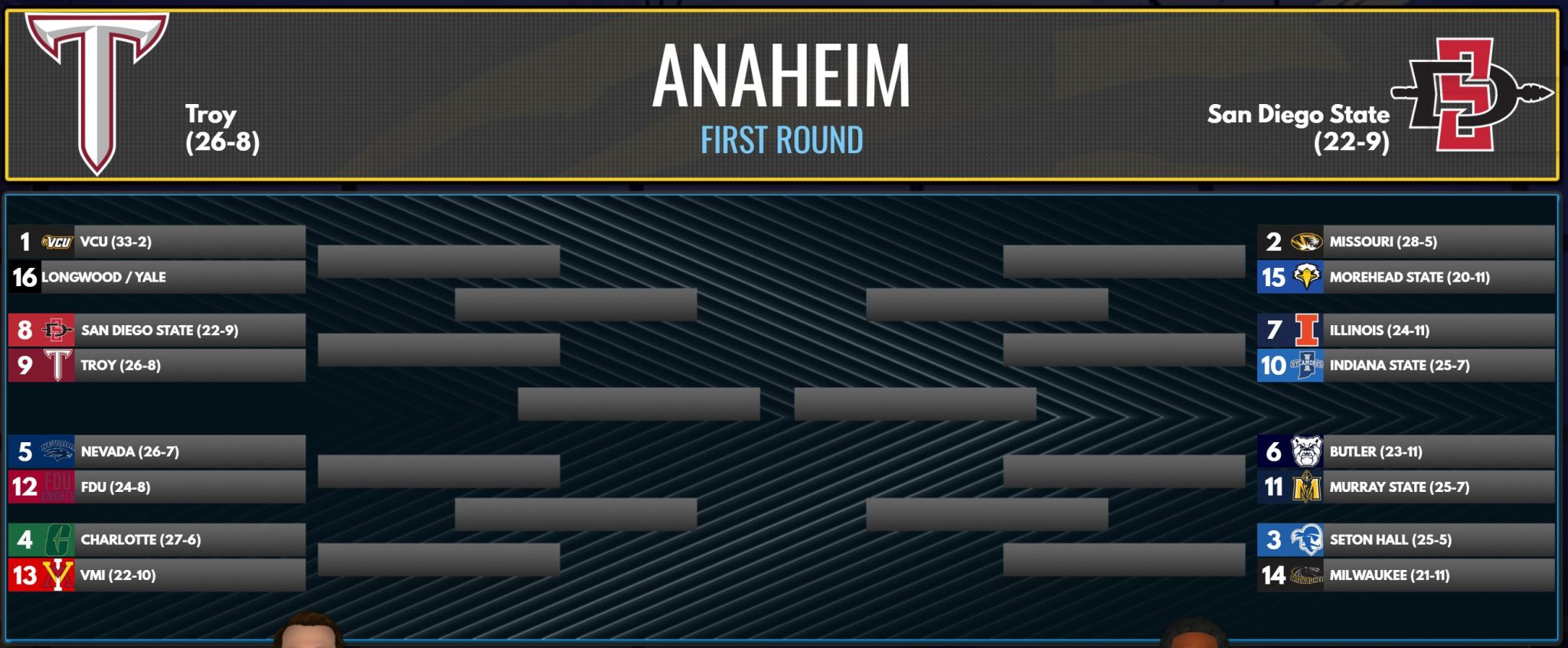
(1) VCU vs. Longwood / Yale
Season Overview
VCU enters Anaheim with one of the strongest statistical profiles in the entire field. The Rams are 33-2, rank second in NET, allow just 63.5 points per game, and pair elite frontcourt production with steady point guard play. VCU senior guard Joe Waldon leads the team at 14.8 points, while VCU freshman forward Jarren Joiner gives them 13.9 points and 10.5 rebounds, VCU sophomore forward Eddie Mosher adds 10.9 points and 8.1 boards, and VCU freshman point guard Aksel Patrick organizes the offense at 6.2 assists per game. That is why the Rams feel so stable: they have a real lead guard, multiple rebounders, and more than one player who can be the most important man on the floor.
Best Wins / Résumé Proof
The résumé backs up the seeding. VCU opened by beating FDU 86-70 with VCU freshman forward Jarren Joiner scoring 24, then beat Pittsburgh 83-68 with Joiner posting 19 points and 16 rebounds. The Rams followed that by crushing Butler 90-60 and Maryland 83-55 in the Legends Classic, then later added wins over Penn State and Princeton. The important thing is not just that VCU won those games. It is that the player-of-the-game profile kept shifting without the team losing its shape. Sometimes it was Joiner scoring and rebounding. Sometimes it was VCU senior guard Joe Waldon leading the offense. Sometimes VCU freshman point guard Aksel Patrick was the assist engine. That kind of repeatable versatility is what makes a one seed feel real.
X-Factor
The X-factor is whether the play-in winner can keep VCU from turning the game into a rebounding avalanche. Longwood would bring a backcourt led by Longwood senior point guard James McCoy, who averages 10.2 points and 5.1 assists, plus Longwood senior guard Malik Elleby at 11.5 points. Yale would counter with a more dangerous two-guard scoring setup through Yale junior guard Terrell Brown at 12.9 points and Yale senior point guard Adonis Dawson at 12.5 points and 5.0 assists. But the underlying problem for either team is the same. If Patrick is controlling tempo and Joiner plus Mosher are owning the glass, VCU has too many ways to squeeze the life out of the game before the underdog backcourt can really matter.
(8) San Diego State vs. (9) Troy
Season Overview
This is one of the more fascinating 8-9 games in the bracket because the two teams arrive with very different offensive identities. San Diego State is more controlled and more interior-reliable. San Diego State junior center Eric Tuck averages 15.2 points and 8.4 rebounds, freshman center Arnaud Géromé gives the Aztecs another 11.2 points and 8.6 boards, freshman guard Ahmad Odom scores 11.9 a night, and junior guard Desmond Anderson drives 5.2 assists per game. Troy is the more explosive team. The Trojans average 90.4 points per game, with Troy junior center David Booth at 16.1 points, sophomore guard Tyree Mackey at 15.9, junior forward Desmond Garcia at 13.9, and senior point guard Nathan Tulley handing out 7.0 assists. San Diego State has the sturdier frontcourt base. Troy has the bigger offensive pace and more volatility.
Best Wins / Résumé Proof
The case for San Diego State is about consistency and two-big reliability. The Aztecs finished 22-9 with a No. 22 NET and a 15-3 league mark, and their stats profile shows why they survived tough games: Tuck and Géromé consistently gave them interior scoring and rebounding, while Odom gave them a perimeter release valve. Troy’s proof is more about offensive strain. The Trojans went 26-8, posted a 14-4 conference record, and their lineup shows multiple ways to pressure a defense. Booth is the most efficient scorer in the matchup, Mackey is the highest-usage guard, Garcia stretches the floor from the 4, and Tulley is clearly the best pure distributor on the floor. This is one of those 8-9 games where the résumé case is not about one dazzling upset. It is about which structure you trust more: San Diego State’s size or Troy’s volume.
X-Factor
The X-factor is whether Troy can keep San Diego State junior center Eric Tuck and freshman center Arnaud Géromé from setting the physical terms. If the Aztecs are winning the paint and junior guard Desmond Anderson is keeping the assist line healthy, San Diego State probably looks like the cleaner tournament team. But if Troy senior point guard Nathan Tulley turns this into a spread-possession game and Tyree Mackey plus Desmond Garcia are forcing San Diego State’s bigs to defend in space, Troy can absolutely bend the matchup its way. This is the kind of first-round game where one team has the stronger floor and the other has the more dangerous offensive ceiling.
(5) Nevada vs. (12) FDU
Season Overview
Nevada looks like a dangerous five seed because the Wolfpack can score without depending on one player to do everything. Nevada junior guard Charles Graham averages 12.2 points, junior guard Tony Caskill adds 9.3 points and 5.5 assists, and the schedule repeatedly shows D. Blunt, D. Blackmon, B. Martin, and T. King surfacing in the biggest games as scorers or rebounders. FDU is different. The Knights are more backcourt-heavy and much more streak-based. FDU sophomore point guard Glen Stokes leads the team at 12.6 points and 4.8 assists, junior guard Micah Wellman adds 11.6, and the schedule shows P. Shields and S. Banks repeatedly carrying scoring and rebounding burdens. Nevada feels broader. FDU feels more reliant on the top guard line holding up.
Best Wins / Résumé Proof
Nevada has better top-end proof. The Wolfpack beat Louisville 70-65, beat Washington 93-78, beat Troy 91-86 on the road, and consistently got quality creation from Nevada junior guard Tony Caskill, who posted assist lines of 8, 7, 6, 7, and 5 in the early part of the schedule. D. Blunt delivered the headline scoring nights, including 29 against Indiana and 23 at Troy. FDU’s résumé is more about momentum. The Knights are 24-8 with an 18-game winning streak, and after a rough start they pieced together a run built around Glen Stokes, P. Shields, Micah Wellman, and S. Banks. That makes FDU dangerous in the classic 12-seed sense: not because the résumé is stronger, but because the current form is real and the backcourt can make a favorite uncomfortable.
X-Factor
The X-factor is whether Nevada can keep the game flowing through Tony Caskill’s playmaking rather than needing one of its scorers to rescue possessions late. If Caskill is organizing, Charles Graham is scoring in rhythm, and the frontcourt is doing enough on the glass, Nevada should look like the more complete team. FDU’s upset path depends on Glen Stokes turning this into a point-guard problem and getting enough shot-making support from Micah Wellman and P. Shields that the game never settles into Nevada’s preferred balance. This is the exact kind of 5-12 matchup where the favorite’s broader résumé meets the underdog’s hotter recent shape.
(4) Charlotte vs. (13) VMI
Season Overview
Charlotte enters as a strong four seed because the 49ers are built on a very clear frontcourt-and-guard support structure. Charlotte senior forward Michael Lofton averages 9.5 points and 7.4 rebounds, senior wing Morris Cobb adds 10.6 points and 4.1 boards, and senior point guard Brian Sawyer handles 4.2 assists per game. Around them, the schedule also shows D. Merton, C. Grant, and T. Lyday popping in important games, which gives Charlotte more lineup flexibility than a typical team in this range. VMI is more guard-centered. VMI sophomore guard Dontrell Valdez averages 12.8 points, junior guard Brett McKnight adds 12.7 points and 4.8 assists, and the Keydets’ offense clearly depends on that backcourt producing enough for the rest of the lineup to survive around it. Charlotte is more balanced. VMI is more dependent on the guards driving everything.
Best Wins / Résumé Proof
Charlotte has more meaningful proof. The 49ers played Stanford to an 88-82 road loss, lost to Notre Dame by only seven, and still built a 27-6 season with a No. 7 NET. Their better results show the same formula repeatedly: Morris Cobb as a scoring wing, Michael Lofton as the rebound anchor, and Brian Sawyer as the guard who keeps the offense connected. VMI’s résumé is respectable but thinner. The Keydets reached 22-10, yet the early visible results include losses to Alabama State, Alcorn State, and Pacific, with Brett McKnight repeatedly having to lead both the scoring and assist categories. That can win games in the Southern Conference. It is harder to trust against a four seed with this much structural balance.
X-Factor
The X-factor is whether VMI can keep this from becoming a Charlotte rebounding-and-defensive-possession game. If Charlotte senior forward Michael Lofton is cleaning the glass and Brian Sawyer is getting the 49ers into their normal offense, then Charlotte should have enough size and stability to grind this out. VMI’s path depends on Brett McKnight and Dontrell Valdez turning it into a guard shot-making contest, where Charlotte cannot simply lean on balance and second chances. The problem for the 13 seed is that Charlotte does not need one player to dominate. The 49ers just need their core trio to do what it has done all season.
(2) Missouri vs. (15) Morehead State
Season Overview
Missouri has one of the clearest star-led profiles of any two seed in the field because Missouri freshman guard Donald Caron is not just a lead scorer. He is one of the most dominant offensive players in the entire bracket. Caron averages 31.0 points, 7.5 rebounds, and 4.8 assists per game, while senior guard Marlon Kincaide adds 11.8 points and 4.0 assists, and the frontcourt contributes through Devereaux Lynn and Regis Saylor on the glass. Morehead State is a respectable 15 seed with real balance. Junior center Chris King leads the Eagles at 14.1 points and 7.2 rebounds, junior guard Kyle Cravens scores 11.5, senior wing Jibran Timmons adds 11.3 and 6.3 rebounds, and junior point guard Sean Lilly drives 4.5 assists per game. But even a balanced 15 seed looks overmatched when the opponent has the best individual offensive force in the game by a huge margin.
Best Wins / Résumé Proof
Missouri’s résumé is full of Caron detonations. He scored 20 at Virginia, 41 against UCF, 39 against Niagara, 36 at Louisville, 36 against Charleston, and 36 against George Mason in the opening portion of the schedule alone. That matters because it shows both the ceiling and the repeatability. This is not a one-night heater. This is Missouri’s season-long offensive structure. Morehead State’s case is built on steadier balance. The Eagles beat Georgia State with Chris King scoring 20, beat Bradley with Sean Lilly scoring 17 and handing out 6 assists, beat Marshall behind Lilly’s 24, and beat Longwood 94-76 with Kyle Cravens leading the scoring. That is the résumé shape of a competent underdog. It just is not the same tier of top-end proof Missouri brings.
X-Factor
The X-factor is whether Morehead State can force the game to be about collective execution rather than Donald Caron’s shot volume. If Morehead State junior point guard Sean Lilly is controlling tempo, Chris King is holding up on the interior, and the Eagles are spreading the scoring burden across Lilly, Cravens, Timmons, and King, they can at least try to make Missouri play a full 40-minute game. But that is the challenge: Missouri’s best player is so explosive that even a disciplined underdog can be broken by one stretch of Caron offense. If he gets to his usual scoring band and the Tigers get enough secondary support from Kincaide and the frontcourt, the 2-vs-15 math becomes unforgiving very quickly.
(7) Illinois vs. (10) Indiana State
Season Overview
This is one of the more intriguing 7-10 games in Anaheim because both teams have guard play, but they use it differently. Illinois is built on a balanced high-major backcourt with senior guard Greg Hammond at 12.3 points, senior forward Ryan Smith at 12.2 points and 7.5 rebounds, and junior point guard Chris Franklin running the offense at 5.5 assists per game. Indiana State is more spread-out and more offensively volatile. Sophomore guard Carmello Wilson leads the Sycamores at 13.1 points, senior guard Jake Blackwell adds 9.0 points and 4.8 assists, and the frontcourt support comes from Jason Burrough, Ryan Smith, and Larry Harris. Illinois looks more physical and more proven. Indiana State looks more likely to win through pace and changing scoring sources.
Best Wins / Résumé Proof
Illinois has the stronger résumé. The Illini opened 5-0 with wins over Arizona State, TCU, and Arkansas, and those games showed the same broad structure the team still relies on. Illinois junior point guard Chris Franklin kept the assist numbers healthy, Ryan Smith and Magic Chandler handled rebounding and interior scoring, and Hammond plus DeShawn Daniels gave the perimeter enough punch to survive close games. Indiana State’s best visible proof is more disruptive. The Sycamores beat UAB 101-86 in overtime, beat Virginia 66-55, and got repeated scoring bursts from V. Underwood and Carmello Wilson, with Jake Blackwell serving as the lead creator. That is enough to make the 10 seed real, but Illinois still owns the better combination of league quality and résumé wins.
X-Factor
The X-factor is whether Indiana State can keep Illinois from turning this into a frontcourt-plus-point-guard control game. If Illinois junior point guard Chris Franklin is making easy reads and Ryan Smith is winning enough of the rebound battle, Illinois probably has too much structure. Indiana State’s chance depends on Carmello Wilson becoming the best scorer in the game and Jake Blackwell making sure the Sycamores’ offense does not get flattened into one-option basketball. This feels like one of those first-round games where the underdog has enough offense to be dangerous, but only if the favorite’s size and organization never fully settle in.
(6) Butler vs. (11) Murray State
Season Overview
Butler brings a stronger star tandem into this game than most six seeds do. Freshman wing Presley Rider averages 19.9 points and 7.0 rebounds, while freshman point guard Kerby Hill adds 16.8 points and 5.4 assists. That immediately gives the Bulldogs two high-usage players who can score, create, and absorb pressure possessions. Around them, Mike Harper and Andrew Johns stabilize the glass. Murray State is not nearly as top-heavy, but the Racers are cohesive. Sophomore guard Darius Branch scores 10.7 points and rebounds well for a guard, Randell Andersen adds 10.0 points and 3.7 assists, and the schedule repeatedly shows T. Taylor, J. Meier, and D. Sampson surfacing as the scoring or rebounding leaders in different wins. Butler has the better top-end duo. Murray State is a little more committee-driven.
Best Wins / Résumé Proof
Butler’s best wins are exactly the kind of proof a six seed wants. The Bulldogs beat UC Santa Barbara in overtime behind Presley Rider’s 31, beat Nevada with Rider scoring 24, beat Georgia 77-48 with Kerby Hill dropping 30, and later won at UNLV with Rider back in the 20s. That tells you something important: Butler’s two best players are not just high scorers in the aggregate. They have already had player-of-the-game nights against tournament-level opposition. Murray State’s résumé is respectable but more modest. The Racers beat Colorado State, Princeton, and Boise State, and their better games often came when T. Taylor was the scorer and J. Meier or R. Andersen handled the passing load. That is workable. It is not as threatening as Butler’s proven two-man star pressure.
X-Factor
The X-factor is whether Murray State can make Butler’s offense depend too heavily on Presley Rider and Kerby Hill having to solve everything themselves. If the Racers keep the game in a narrower possession band and get balanced support from Darius Branch, Randell Andersen, and the rest of the guard line, they can make the six seed sweat. But Butler’s upside in this matchup is obvious. If Kerby Hill is organizing and Rider is scoring efficiently, then the Bulldogs have the best two players on the floor and enough frontcourt support to keep Murray State from turning this into a pure guard scramble.
(3) Seton Hall vs. (14) Milwaukee
Season Overview
Seton Hall looks like a sturdy three seed because the Pirates have real role clarity across the lineup. Sophomore wing Braylon Madsen leads at 14.8 points, sophomore wing Marc Harrison adds 12.4 points and 6.4 rebounds, senior point guard Cedric Cameron drives 6.4 assists, and sophomore center Kane Newell gives them 9.5 points and 7.6 rebounds in the middle. That is a well-built tournament team because it has shot creation, playmaking, and frontcourt stability. Milwaukee is more guard-driven. Senior guard Esmond Metcalfe scores 10.8 points and nearly 5 assists per game, sophomore point guard Randell Vega adds 8.8 points and 4.1 assists, and the schedule shows J. Rodriguez repeatedly surfacing as the Panthers’ biggest scorer. Seton Hall is broader. Milwaukee is more dependent on the backcourt carrying the burden.
Best Wins / Résumé Proof
Seton Hall has better proof. The Pirates opened by beating BYU 86-79, then rolled through early-season games with wins over UIC, App State, SIU Edwardsville, and Stephen F. Austin. In that stretch, the featured player kept changing. Braylon Madsen had 17, 24, and 20-point nights. Cedric Cameron posted 8-, 10-, 8-, and 27-point organizing or scoring performances. Marc Harrison and Kane Newell kept showing up on the glass. Milwaukee’s résumé is good enough to earn respect. The Panthers beat Ohio State 61-58 on the road and opened 4-0, while J. Rodriguez posted 25, 31, and 34-point explosions in early wins. But Milwaukee’s best case still depends more heavily on one scorer getting loose than Seton Hall’s does.
X-Factor
The X-factor is whether Milwaukee can turn this into a perimeter-initiative game where Randell Vega and Esmond Metcalfe are making the primary decisions and J. Rodriguez gets enough volume to pressure the scoreboard. If that happens, the Panthers can at least test whether Seton Hall is as comfortable outside its normal half-court balance as its seed suggests. But Seton Hall’s edge is that it does not need one script. If Cedric Cameron is distributing, Braylon Madsen is handling the scoring load, and Kane Newell is winning enough of the interior work, the Pirates should eventually separate. Milwaukee has enough guard play to make this interesting. Seton Hall has more answers.
IN GAME DATE: March 13