📄 2042 Bench Efficiency Monsters: Rotation Spark Plugs Who Deserve More Run
- Player Spotlight
 CBGM News
- 0
- 7 minutes read
Every season in college basketball, the box scores reveal hidden gems — players who, in limited minutes, produce at a rate that screams for more opportunity. The 2042 campaign has uncovered a group of bench spark plugs, averaging only 8–10 minutes a game, yet scoring at a pace that rivals established stars when adjusted to per-36 minutes.
The key isn’t just their raw numbers. It’s how they get those points — and why their styles make them so dangerous in short bursts.
⚡ Derrik Stephens (Appalachian State) —
25.9 PTS per 36
Stephens is pure aggression. He averages 6.2 points in 8.6 minutes, almost all coming from hard drives and midrange pull-ups. Unlike some efficiency monsters who live behind the arc, Stephens isn’t volume-dependent — his scoring is built on quick touches and decisive moves. For App State, that makes him an ideal momentum-shifter when the offense stalls.
🎯 Edison Snyder (Norfolk State) —
23.6 PTS per 36
Snyder is a hybrid piece. Yes, he puts up 6.4 points in 9.8 minutes, but he adds nearly 3 rebounds and 0.7 blocks as well. His offense comes from putbacks and strong cuts into the lane. Norfolk State doesn’t need him to create shots; he thrives by finishing plays others start. Snyder’s profile suggests that if his minutes expand, his efficiency may hold because it isn’t shot-volume reliant.
🏀 Sam Rushing (Ball State) —
23.2 PTS per 36
Rushing lives up to his name — he’s fast, decisive, and not afraid to fire. In 9.1 minutes a night, he contributes nearly 6 points, with over half of that production tied to perimeter shooting (0.6 threes per game). He’s the classic “green light” shooter off the bench, and Ball State has used him as a second-unit flamethrower. The concern? Can he maintain rhythm with limited minutes, or does he need more consistent run to be truly lethal?
🐱 Hudson Fuentes (Eastern Kentucky) —
23.2 PTS per 36
Fuentes brings spacing. Averaging 5.6 points in 8.7 minutes, his efficiency is built on the long ball (1.2 made threes per game). That’s an elite clip for someone playing such limited minutes. Eastern Kentucky deploys him as a stretch option, and he’s answered by dragging defenders out of the paint. His value lies in fit — he doesn’t need heavy usage to change the geometry of the floor.
🔥 Others Making Noise
-
Jarrett Cherry (St. Bonaventure) — 23.1 per 36, another perimeter-driven scorer, with a reputation for catch-and-shoot threes.
-
Marc Bird (Niagara) — 23.0 per 36, mixes inside scoring with rebounding (3.2 RPG in just 8 minutes).
-
Doc Attaway (Notre Dame) — 22.8 per 36, balances drives with steady defensive presence (0.5 steals, 0.3 blocks).
-
Clendon Caron (Missouri) — 22.7 per 36, scores via rim runs and transition buckets.
-
Desmond Melendez (Appalachian State) — 22.3 per 36, a shooting complement to Stephens’ slashing, giving App State a versatile bench combo.
-
Daryle Bird (Gardner-Webb) — 22.2 per 36, selective scorer who maximizes possessions.
-
Lonnie Deverage (Samford) — 22.0 per 36, sneaky scorer who often strikes from the arc.
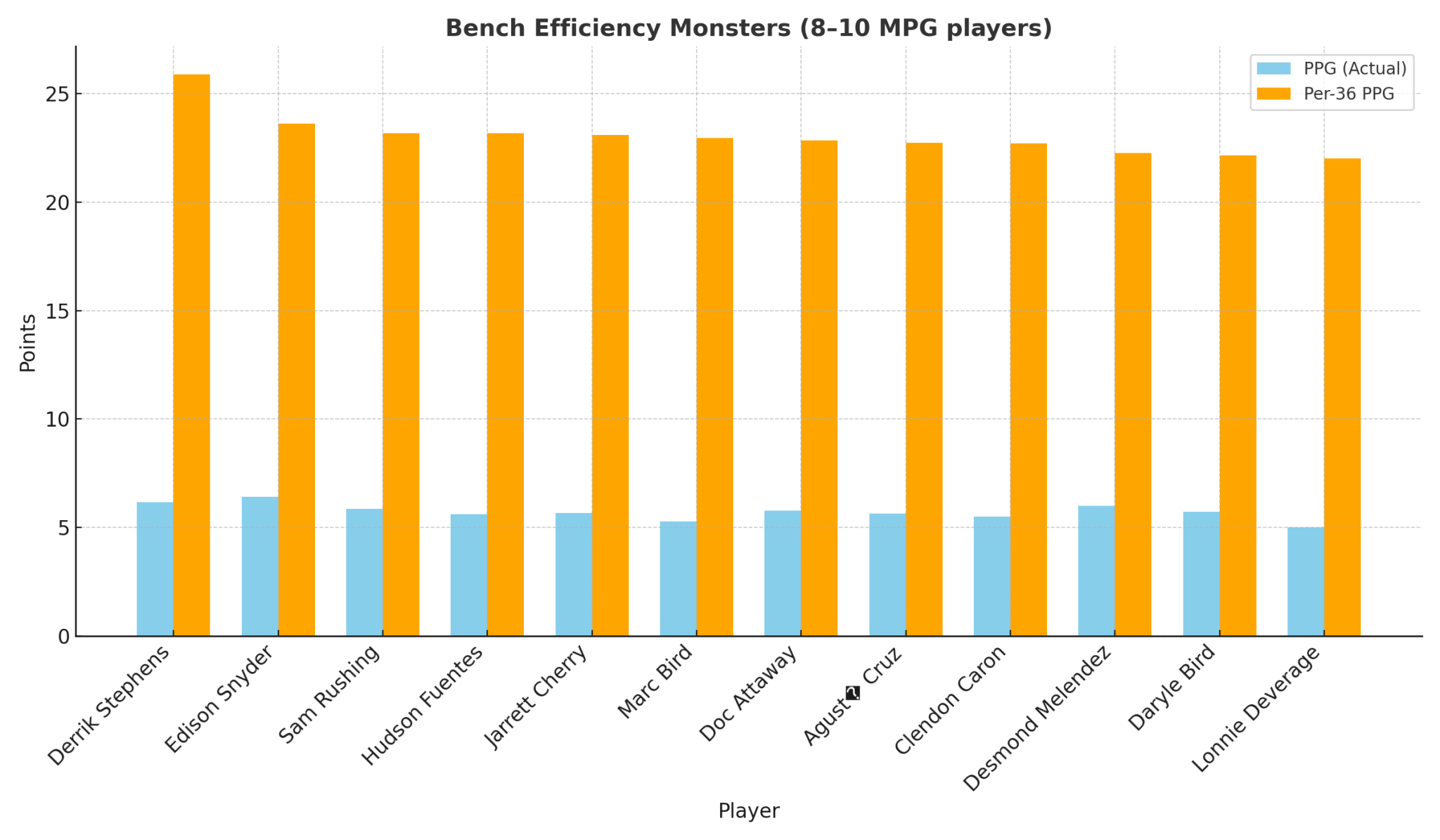
Blue bars = actual points per game in 8–10 minutes. Orange bars = per-36 scoring pace if scaled to starter minutes.
The chart shows just how wide the gap is between current production and potential. These aren’t one-minute, garbage-time anomalies — they’re consistent 8–10 minute role players making the most of their time.
📖 The Takeaway
The “Bench Efficiency Monsters” of 2042 aren’t just padding box scores; they’re redefining the value of short rotations. Some do it with shooting gravity (Fuentes, Rushing, Cherry). Others thrive on hustle, cutting, and physicality (Snyder, Bird, Attaway).
The question for coaches is simple:
-
Do you expand their roles and risk exposing them defensively or physically?
-
Or do you preserve them as lethal spark plugs, able to change games in 10 minutes flat?
For now, these players remind us of one truth in college basketball: it’s not about how long you’re out there — it’s about how you use every second you get.